%20(1).png)
The Professional Guide to Choosing a Custom Women’s Clothing Manufacturer in 2026

Updated: Jul 9
In 2026, a fashion brand's success is no longer measured by the size of its marketing budget, but by the speed of its supply chain. If your sample turnaround takes more than ten days, you've already lost the seasonal window to a more agile competitor. Finding a reliable custom women's clothing manufacturer is the single most important decision you'll make for your brand's growth this year. You likely know the frustration of inconsistent sizing in bulk runs and the burden of high minimum order quantities that freeze your working capital. These logistical hurdles don't just slow you down; they threaten your ability to respond to a market that demands "Quiet Luxury" and sustainable precision.
This guide provides a professional roadmap to identify and partner with a world-class production partner to scale your apparel line with speed. You'll learn how to evaluate technical expertise and manage the complexities of the 2026 trade environment, including the current 10% Section 122 tariffs and EU Digital Product Passport requirements. We'll cover everything from fabric sourcing transparency to the mechanics of small-batch production. By the end, you'll have a clear system for turning your designs into market-ready collections without the typical manufacturing delays.
Table of Contents
Understanding the Role of a Custom Women’s Clothing Manufacturer
The relationship between a designer and their custom women's clothing manufacturer has undergone a fundamental shift. In 2026, this partnership is no longer a simple hand-off of sketches to a factory floor. It's a high-stakes logistical collaboration. Successful brands now view their manufacturer as a strategic partner that manages technical risks and supply chain volatility. This is particularly true in women’s fashion, where complex silhouettes and varied fabric weights require a specialized level of expertise that generic production houses can't provide. Precision in fit and construction is the baseline for survival.
The global clothing industry is moving away from the rigid, long-lead seasonal models of the past. Today's market rewards agility. Instead of massive inventory bets placed six months in advance, brands are shifting toward demand-led production. This allows for smaller initial runs and rapid replenishment based on real-time sales data. It reduces the risk of unsold stock and aligns with new global regulations regarding textile waste. Reliability is now measured by a factory's ability to pivot quickly without sacrificing the structural integrity of the garment.
FPP vs. CMT: Which Model Fits Your Brand?
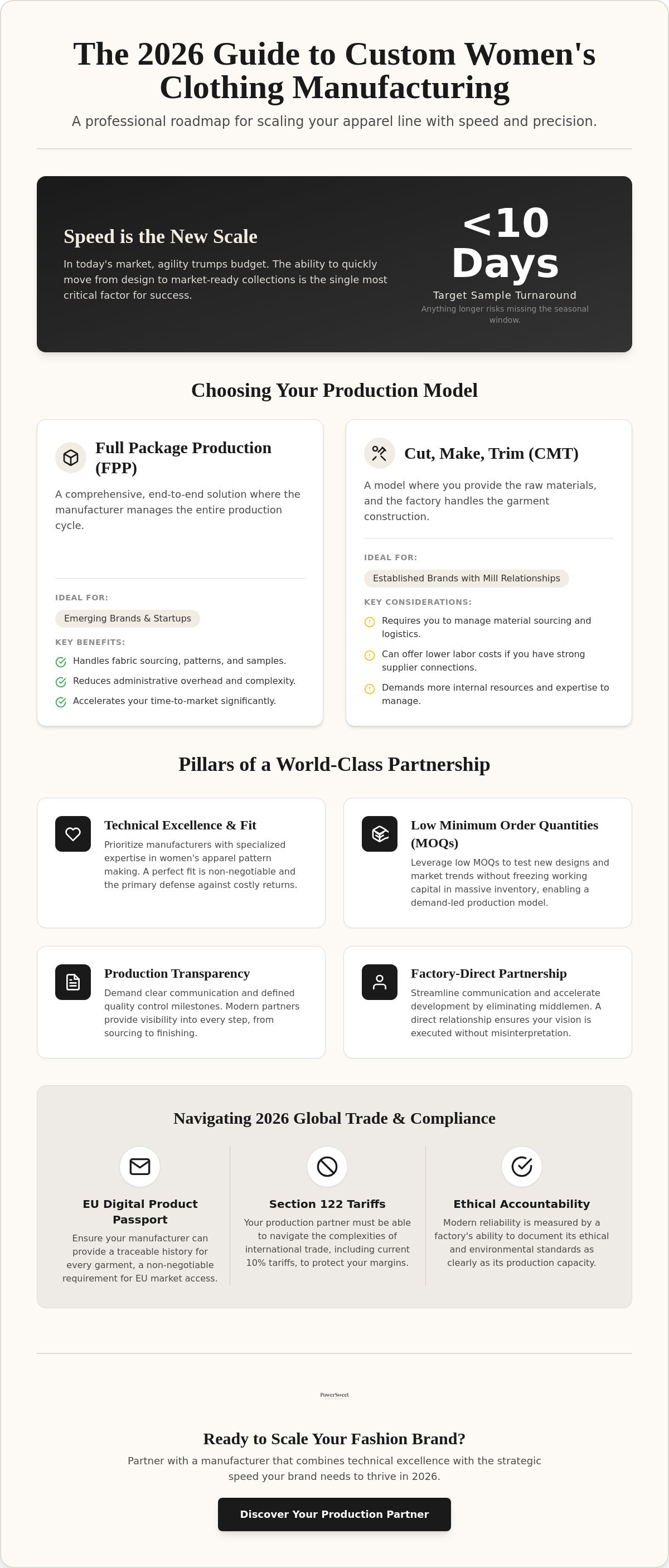
Choosing between Full Package Production (FPP) and Cut, Make, Trim (CMT) is a critical operational decision. Full Package Production (FPP) is a comprehensive manufacturing solution that manages the entire production cycle from sourcing to final delivery, making it the ideal choice for emerging brands. It's a hands-off approach where the factory handles fabric sourcing, pattern making, and sample development. Conversely, CMT is better suited for established brands that already have direct relationships with fabric mills. While CMT can offer lower labor costs, it requires you to manage the logistics of getting raw materials to the factory on time. If your priority is speed and reducing administrative overhead, FPP is almost always the more efficient path.
The Evolution of Apparel Manufacturing Standards
Manufacturing standards in 2026 are defined by transparency and ethical accountability. New regulations like the EU’s Digital Product Passport mean every garment must have a traceable history. Your choice of a custom women's clothing manufacturer must reflect these benchmarks. Modern factories now prioritize direct, digital communication to eliminate the misinterpretations that often plague middleman-heavy production. We see a move toward "Textile-to-Textile" recycling and the use of mono-materials to simplify the end-of-life process for garments. Reliability now depends on a factory's ability to document its ethics and environmental impact as clearly as its production capacity.
Technical Excellence in Women’s Apparel: Pattern Making and Fabric Sourcing
Technical precision is the foundation of a successful fashion brand. When you partner with a custom women's clothing manufacturer, you aren't just buying labor; you're investing in their technical library and engineering capabilities. The difference between a garment that sits on a retail shelf and one that becomes a best-seller often comes down to the millimeter-perfect execution of a tech pack. These blueprints serve as the definitive contract between your vision and the factory's output, ensuring that every seam, stitch, and measurement is executed with industrial accuracy.
Achieving this level of consistency requires a deep understanding of apparel manufacturing statistics and quality benchmarks. Industry data shows that fit-related returns are the primary drain on profitability for online apparel retailers. By prioritizing technical excellence during the development phase, you can mitigate these risks before bulk production begins. This starts with the transition from 2D sketches to production-ready patterns that account for the unique draping requirements of women's silhouettes.
The Science of the Perfect Fit
Pattern making for women’s apparel is a specialized discipline. Unlike unisex or men’s garments, women’s silhouettes require complex darting and shaping to ensure a flattering fit across a diverse range of body types. Modern manufacturers use 3D pattern-making software to simulate how fabrics like Crepe or Lyocell will drape in motion. This digital prototyping reduces the number of physical sample rounds needed, saving you both time and capital. Professional grading techniques are then applied to ensure size inclusivity, maintaining the design's integrity from size XS to 3XL.
Strategic Material and Trim Sourcing
Fabric selection defines the longevity and feel of your collection. In 2026, the focus has shifted toward high-performance, sustainable materials such as Polyamide and bio-cellulosic Lyocell. A seasoned custom women's clothing manufacturer maintains a robust network of local suppliers to secure these materials without the delays of international shipping. This proximity allows for better quality control and faster response times to market trends. Beyond the base fabric, the specialized trims you choose can significantly elevate a garment's perceived value.
Durability: We ensure fabrics are tested for industrial washing, colorfastness, and pilling resistance to guarantee longevity.
Hardware: Specialized trims like custom-branded buttons and high-grade zippers are essential for a premium brand identity.
Labels: High-definition woven labels and sustainable hangtags provide the final touch of professional branding.
The right hardware doesn't just look better; it functions better over the life of the garment. If you're looking to refine your next collection, consider starting with professional fabric sourcing and sample development to see the difference technical expertise makes.
The Strategic Advantage of Low MOQ and Scalable Production
Inventory is often the largest financial burden for a growing fashion label. In 2026, the traditional model of ordering thousands of units based on a "gut feeling" is obsolete. High minimums tie up your capital and leave you vulnerable to shifting consumer tastes. By partnering with a custom women's clothing manufacturer that offers low Minimum Order Quantities (MOQs), you can implement a "test and repeat" strategy. This approach lets you validate a design with a small audience before committing to a full-scale bulk run.
The economics of production are shifting. While per-unit costs naturally decrease as volume increases, the hidden costs of overproduction, such as warehousing, insurance, and deadstock, often outweigh those initial savings. Small-batch manufacturing allows you to preserve your cash flow for marketing and brand development. It transforms your supply chain from a rigid expense into a flexible asset that responds to real-world demand rather than theoretical forecasts. Reliability in 2026 is defined by this ability to scale without the weight of excess inventory.
Scaling from Boutique to Global Brand
Growth shouldn't be a gamble. Low MOQs facilitate more frequent collection drops, which keeps your storefront fresh and your customers engaged. You might start with a 50-piece test run of a new dress silhouette to gauge the click-through and conversion rates. Once the data confirms a winner, you can transition to a 1,000-piece bulk production run with the same factory. This staged approach manages your risk while ensuring that your most popular items never stay out of stock for long. It's about building a sustainable foundation where every piece produced has a verified buyer.
The Agile Manufacturing Workflow
Ensuring Quality Control and Production Transparency
Quality is the only metric that protects your brand from costly returns and negative reviews. A professional custom women's clothing manufacturer shouldn't just promise quality; they must prove it through a transparent, documented process. This transparency starts with "Open-Door" access. You should understand exactly who is making your garments and under what conditions. It's about moving beyond vague promises to a system where every stitch is verifiable. Reliability is built on this foundation of industrial accountability and shared visibility.
Sample development is the most critical phase of production. It's the physical proof of your tech pack's viability. In 2026, a 10-day sampling window is the industry standard for agile brands. This first prototype acts as the blueprint for bulk success. If the sample isn't perfect, the bulk run won't be either. We recommend an iterative approach where you provide specific, technical feedback on fit and finish. Seeing a finished garment in your chosen fabric is the only way to justify committing to bulk production fees.
The 10-Day Sampling Benchmark
Speed doesn't have to compromise precision. A 10-day sampling benchmark allows you to test silhouettes without losing momentum in your marketing calendar. Use this phase to evaluate the factory's ability to interpret complex draping or technical seam work. When giving feedback, be as specific as possible. Instead of saying a garment "feels tight," specify the measurement variance against your tech pack. This technical clarity allows the factory to execute corrections with surgical precision, ensuring the second iteration is production-ready.
Implementing Rigorous Quality Checks
Industrial quality control requires a multi-stage checklist that covers every aspect of the garment's construction. We utilize three distinct inspection points to maintain standards. Pre-production checks verify fabric quality and trim accuracy before the first cut is made. Mid-line inspections check seam strength and construction halfway through the run to catch systemic errors early. Finally, the final garment inspection measures every piece against the approved tolerance levels in the tech pack, checking for colorfastness and measurement accuracy.
Seam Strength: Ensuring all stress points are reinforced for long-term wear.
Measurement Tolerance: Verifying that bulk runs don't deviate from approved sizing.
Colorfastness: Testing fabrics to ensure they don't bleed or fade after industrial washing.
While some brands hire third-party QC agents, a factory-led quality team is often more efficient because they understand the specific machinery and material quirks of their facility. Transparency means you should always have the right to request a video inspection or a physical visit to the floor. This "Safe Pair of Hands" approach ensures that any quality variances are identified and corrected before the shipment leaves the factory. If you're ready to secure your supply chain, request a quality control checklist and production quote today.
Partnering with PowerSweet Fashion for End-to-End Production
Choosing a custom women's clothing manufacturer is a decision that defines your brand's operational ceiling. At PowerSweet Fashion, we eliminate the layers of middleman communication that often lead to production errors. By providing direct factory access, we ensure your technical requirements are heard directly by the pattern makers and seamstresses executing the work. This proximity to the production floor isn't just about transparency; it's about the precision required to scale a modern fashion label. We invite brand owners to visit our facility, meet our production team, and oversee the quality control milestones that guarantee a flawless final product. Partnership is the engine of our mutual success.
Reliability in the garment industry is built on hard numbers and proven turnarounds. We understand that in 2026, a delay of even a few days can mean a missed seasonal opportunity. That’s why we’ve optimized every stage of our workflow to prioritize speed and responsiveness. We don't just make clothes; we provide the logistical stability you need to focus on marketing and design. Our systems are designed to lower the barrier to entry for emerging labels while providing the scale necessary for established global brands.
The PowerSweet Advantage
Our Guangzhou-based facility sits at the heart of the world’s most efficient textile supply chain. This strategic location allows us to source high-grade materials and specialized trims with a speed that other regions simply can't match. We've built our systems to support fast-growing labels through low Minimum Order Quantities, starting at just 50 pieces per style. This commitment to small-batch agility means you can test new designs without the financial risk of massive inventory. From initial fabric sourcing to the final delivery at your warehouse, our end-to-end support removes the logistical friction from your growth strategy.
Start Your Production Journey Today
Getting started is a straightforward, methodical process. Once you submit your tech pack, our team provides an initial quote and technical assessment. We prioritize speed without sacrificing the meticulous care your designs deserve. Our industry-leading timeline delivers finished samples in just 10 days, followed by bulk production runs that are completed in 15 to 20 days. This rapid cycle allows you to respond to market trends in real-time. Join the global fashion brands that use PowerSweet’s production engine to scale with precision and confidence. Your vision deserves a manufacturing partner that moves as fast as the market does.
Future-Proof Your Fashion Supply Chain
The successful fashion brand of 2026 is built on a foundation of technical precision and supply chain agility. You've seen how professional pattern making ensures a consistent fit and why low MOQs are the key to protecting your capital while testing new designs. Choosing the right custom women's clothing manufacturer isn't just about finding a factory; it's about securing a partner that understands the mechanics of speed and the importance of end-to-end transparency. Reliability is the ultimate competitive advantage.
PowerSweet Fashion provides the industrial engine needed to turn your creative vision into a physical reality. With our 10-day sample turnaround and flexible low MOQ options, we help you navigate the complexities of the modern market without the traditional risks of overproduction. Our facility handles every step, from meticulous fabric and trim sourcing to final quality control inspections. This comprehensive approach ensures that your brand remains competitive and responsive to shifting consumer trends. It's time to move from concept to collection with total confidence.
Request a Production Quote from PowerSweet Fashion to begin your journey toward a more efficient, scalable production model. We're ready to help you scale your collection with precision and speed. Let's build your brand's future together.
Frequently Asked Questions
What is the typical MOQ for a custom women’s clothing manufacturer?
The typical MOQ for a professional custom women's clothing manufacturer can range from 50 to 500 pieces per style. At PowerSweet Fashion, we specialize in low MOQs starting at 50 pieces to support brands in testing market demand. This flexibility prevents you from tying up excessive capital in unsold inventory. It allows for a more agile "test and repeat" model that is essential for surviving the fast-paced 2026 fashion cycle.
How long does the sample development process take?
Sample development usually takes approximately 10 days from the moment your tech pack is approved. This stage is the most important part of the production journey because it identifies technical issues before they reach the bulk line. Our streamlined sampling process ensures you don't miss seasonal windows. We focus on creating a high-fidelity prototype that serves as the definitive quality benchmark for the entire production run.
Do I need a tech pack to start production with a garment factory?
Yes, you need a comprehensive tech pack to ensure production accuracy and minimize costly mistakes. A tech pack acts as a technical contract between your brand and the factory. It includes detailed measurements, material specifications, and construction diagrams. Without this blueprint, a garment factory cannot guarantee that the final bulk run will match your original design vision. We use these documents to maintain surgical precision during every cut and stitch.
Can a manufacturer help me source specific sustainable fabrics like Lyocell?
A full-service manufacturer will help you source advanced bio-cellulosic fabrics like Lyocell, Modal, and other eco-friendly materials. We leverage our proximity to major textile hubs in Guangzhou to find fabrics that meet the latest EU Digital Product Passport requirements. This direct sourcing ensures your materials are both high-quality and ethically traceable. It also allows us to verify fiber origin and chemical use before production begins.
What is the difference between a clothing manufacturer and a clothing supplier?
A manufacturer physically builds your garments from raw materials, whereas a supplier often acts as a middleman or a distributor of pre-made goods. Working directly with a custom women's clothing manufacturer gives you more control over the technical details and quality standards. It also eliminates the extra fees typically charged by wholesalers. This direct partnership fosters better transparency and allows for faster response times to design changes or production updates.
How do I ensure the sizing is consistent across my entire clothing line?
Sizing consistency is maintained through professional pattern making and standardized grading techniques. We use 3D pattern-making software to simulate fit before the first fabric is cut. During bulk production, our quality control team performs mid-line and final inspections to verify that every piece stays within the approved measurement tolerance. This methodical approach reduces fit-related returns and builds long-term trust with your customer base.
What should I look for when visiting a garment factory in person?
When visiting a factory, you should prioritize seeing their quality control stations and the condition of their machinery. Look for transparency where the production team is willing to show you every stage of the assembly line. Check for organized fabric storage and evidence of ethical labor practices. A well-run facility will have a logical workflow that moves efficiently from cutting and sewing to final pressing and packaging.
How are bulk manufacturing fees calculated?
Bulk fees are calculated based on a combination of material costs, labor complexity, and the total volume of your order. Higher volumes typically reduce the per-unit cost because the setup time for machinery and pattern grading is spread across more garments. We provide a detailed breakdown that includes fabric consumption, trim costs, and manufacturing labor. This transparency helps you understand your margins and plan your retail pricing strategy with precision.


Comments