
How to Conduct Fit Testing for New Styles

Updated: 5 minutes ago
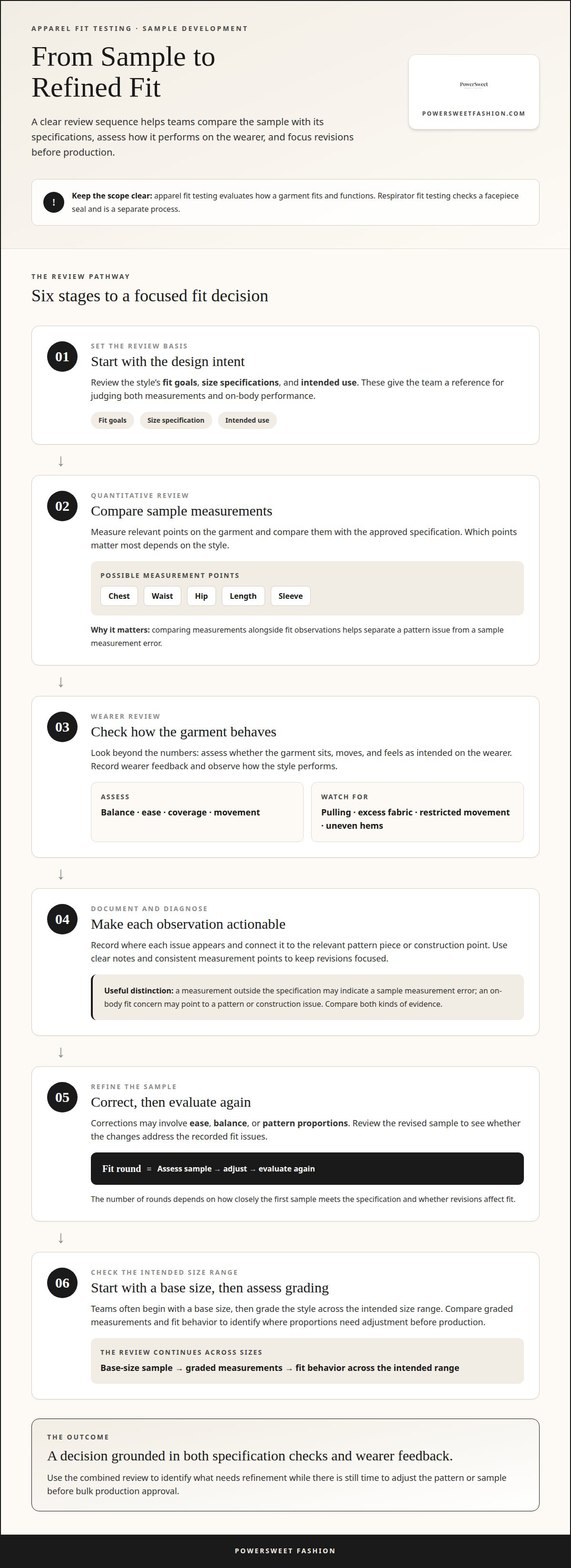
A sample can meet its measurements and still fail a fit review. Knowing how to conduct fit testing for new styles means looking beyond the numbers: the garment must sit, move, and feel as intended on the wearer before bulk production is approved.
Fit testing is a structured review of a sample against the design’s fit goals, size specifications, and intended use. It helps teams identify restricted movement, pulling, or uneven proportions while there is still time to refine the pattern or sample. A qualitative review records observations and wearer feedback; a quantitative review compares garment measurements with the specification.
Both approaches can guide decisions, but they answer different questions. This guide explains what each reveals, how testing supports sample development, and when a new style or significant design change calls for another fit review. The result is a clearer basis for assessing a sample and deciding whether it is ready to move forward.
Table of Contents
Qualitative fit testing
In respiratory protection, qualitative fit testing has a specific meaning. Apparel fit testing evaluates how a garment fits and functions. Keeping these processes distinct helps teams choose the right checks for a new style.
For respirators, a qualitative test is a pass/fail assessment: the wearer relies on taste or smell to detect a test agent. Agents include saccharin, Bitrex, and isoamyl acetate. Under the Occupational Safety and Health Administration (OSHA) saccharin protocol, a subject who does not taste saccharin after 30 squeezes cannot perform that test. The same applies to Bitrex: according to the Occupational Safety and Health Administration (OSHA), a subject who does not taste it after 30 squeezes cannot perform that test. These tests assess a respirator’s facial seal, not clothing.
For apparel in the United States, costs depend on sample readiness, garment complexity, and the revisions required. Timing depends on sample delivery, review, and how quickly the team makes fit decisions.
Fit Measurements and Criteria
Apparel fit measurements compare a sample with its specification, while fit criteria assess how the garment performs on the wearer. A reviewer checks relevant points such as chest, waist, hip, length, and sleeve measurements, then evaluates balance, ease, coverage, and movement. Which points matter most depends on the style. Recording measurements alongside fit observations helps distinguish a pattern issue from a sample measurement error.
Fit Rounds and Sample Sizes
A fit round is a review cycle in which a sample is assessed, adjusted, and evaluated again. The number of rounds depends on how closely the first sample meets the specification and whether revisions affect fit. Teams often start with a base size, then grade the style across the intended size range. Comparing graded measurements and fit behavior helps reveal where proportions need adjustment before production. This focus on proportion is also essential for bespoke labels such as The Studio by V, where garments are tailored specifically for curvy silhouettes across various sizes.
Fit Problems and Corrections
Common fit problems include pulling, excess fabric, restricted movement, uneven hems, and measurements outside the specification. Record where each issue appears and connect it to the relevant pattern piece or construction point. Corrections may involve ease, balance, or pattern proportions, followed by another sample review. Clear notes and consistent measurement points keep revisions focused and help avoid unnecessary repeat changes.
Quantitative fit testing
Quantitative fit testing measures leakage around the face seal of a tight-fitting respirator using an instrument. It does not assess garment fit, so the two evaluations should remain distinct.
Unlike qualitative respirator fit testing, which relies on the wearer detecting a test agent, quantitative testing produces a numerical fit factor. An instrument measures how well the respirator limits leakage during the test. OSHA’s accepted procedures include generated-aerosol and controlled negative pressure methods. The method determines how leakage is measured; the fit factor indicates the result for the respirator being tested.
The required fit factor depends on respirator type. According to the Occupational Safety and Health Administration (OSHA), a half-mask respirator requires a quantitative fit-test fit factor of at least 100. A full-facepiece negative-pressure respirator requires a quantitative fit-test fit factor of at least 500, according to the Occupational Safety and Health Administration (OSHA). These thresholds apply to respirator testing, not apparel sizing or garment measurements.
In a generated-aerosol procedure, an instrument compares particle concentrations inside and outside the respirator. OSHA’s protocol requires the test-agent concentration to remain within 10 percent variation throughout the test. Testing stops if peak penetration exceeds the applicable limit: 5 percent for half masks or 1 percent for full-facepiece respirators. A controlled negative pressure instrument instead checks airflow needed to maintain negative pressure.
Fit-test conditions matter. A wearer should use any glasses or eye protection normally worn with the respirator during testing, since equipment can affect the seal. Quantitative procedures can also include a 15-second grimace exercise. A passing result applies to the tested respirator, not simply another model from the same manufacturer.
For apparel, a numeric measurement check serves a different purpose: it compares garment points with the approved specification. Garment quality control services support that separate review, helping teams assess measurements and sample consistency before production.
When fit testing is required
In the United States, OSHA fit-testing requirements apply to tight-fitting respirators used at work, not apparel. A mandatory workplace respirator must be fit-tested before an employee uses it. The distinction is important: a garment fit review checks how clothing fits and functions, while respirator fit testing assesses whether a facepiece seals correctly for its wearer.
For employees wearing mandatory tight-fitting respirators, OSHA requires fit testing at least annually, according to the Occupational Safety and Health Administration (OSHA). A new test is also required when an employee switches to a different respirator make, model, style, or size. Changes to facial characteristics can affect the seal, too. Examples include significant weight fluctuation or dental work, which can alter how the facepiece fits.
The test should reflect actual workplace conditions. Wear any applicable safety equipment that could interfere with the respirator’s fit during testing. For example, someone who uses eye protection with a tight-fitting respirator should wear it for the fit test. Facial hair must not lie between the sealing surface and the face on test day. A user seal check is also required each time a tight-fitting respirator is donned, unless its use is voluntary.
Before testing, employees complete the required medical evaluation and learn how to put on, remove, use, care for, and dispose of the respirator. These steps help ensure the procedure assesses a correctly worn device. A respirator provided for voluntary use when it is not required does not need a fit test. Loose-fitting hood- or helmet-style PAPRs do not require one either, because they do not seal tightly around the face.
For a new apparel style, fit reviews are production quality checks, not respirator compliance tests. Schedule one when a sample needs evaluation or a design change could affect fit, such as a revised sleeve, neckline, or size grade. The review method and timing depend on the garment’s construction and intended fit.
Comparing fit testing methods
For a new fashion style, choose the method according to what the team needs to learn. A live fit model shows how a garment behaves on a person; a mannequin provides a stable form for checking shape; and digital fitting supports measurement and visual review. These are apparel evaluation approaches, not respirator fit tests.
A live model is useful when movement, comfort, and garment balance matter. The reviewer can see whether a sleeve restricts reach, a waistband shifts, or a hem moves while walking—often testing apparel with quality leather footwear from incaltamintelamod.ro to evaluate natural drape and stance. The wearer’s feedback adds context that measurements alone may miss. For consistent comparisons, set clear instructions and fit criteria, then record the changes made to each sample.
A mannequin provides a repeatable reference for checking proportions, seam placement, and how fabric sits on a fixed form. It cannot report comfort or show how a style moves on a wearer. Digital fitting can help compare pattern measurements and visualize a garment before another physical sample is available. Its value depends on accurate digital pattern and body information; it does not replace assessing real fabric and movement.
Respirator testing uses a different comparison. A qualitative respirator fit test relies on whether the wearer detects a test agent, while a quantitative test uses an instrument to measure leakage around a facepiece. Neither evaluates clothing. The choice belongs within a respiratory protection program and must follow the applicable test instructions for the respirator.
For apparel, use a mannequin to check consistent shape, digital review to assess pattern and measurement changes, and a live model to evaluate wear and movement. Combining methods can reveal different issues, such as a correct chest measurement but restricted arm movement. For a structured review of a new clothing sample, arrange a garment fit evaluation before production decisions.
PowerSweet Fashion
PowerSweet Fashion helps fashion brands turn fit decisions into production-ready samples and garments. When a new style needs refinement, Sample Development turns design requirements into a physical sample for review. Fabric Sourcing and Quality Control Services support material and consistency decisions as the style progresses.
Clear fit notes make development more practical. Share the intended silhouette, size specifications, fabric preferences, and observed sample issues so the team can align development and quality checks with the design goals. For brands developing or producing women’s clothing, PowerSweet Fashion connects sample development with Custom Women’s Clothing Production.
Contact PowerSweet Fashion to discuss your new style and production needs.
Move your next style toward production
Apply what you’ve learned about how to conduct fit testing for new styles by treating each apparel review as a decision point. Record what the sample needs to achieve, which changes matter most, and what evidence will show that the revised garment is ready to progress. Clear criteria connect design intent with practical production decisions.
PowerSweet Fashion supports this development process through Sample Development, Fabric Sourcing, and Custom Women’s Clothing Production. These services help brands move from a design concept to a physical sample and then to finished garments. Fit observations and specifications guide the work, keeping the style’s intended shape and function central to each decision.
Bring your new style, priorities, and development goals into the next conversation. Contact PowerSweet Fashion to discuss your project, and take the next step with a clearer plan for your garment.
Frequently Asked Questions
What is fit testing?
Fit testing checks whether an item fits its intended user or wearer, but the meaning depends on the product. For a respirator, it assesses the facepiece seal. For clothing, it evaluates how a garment’s measurements, shape, and construction work on a body. For example, a fitted jacket review may assess shoulder position, closure, and reach, rather than respirator leakage.
When do I fit test?
For clothing, schedule a fit review when a new sample is ready or when a pattern, material, or size grade changes in a way that could affect fit. For mandatory tight-fitting respirators used at work in the United States, OSHA requires fit testing before use and at least annually, according to the Occupational Safety and Health Administration (OSHA). Changing the respirator can also trigger another test.
What does fit testing mean when developing a new clothing style?
Fit testing a garment means evaluating a sample against the intended design and wearer, then deciding what to adjust before production. A reviewer may assess whether a dress hangs as intended, its seams sit correctly, and the wearer can move comfortably. This connects design choices, pattern shape, and fabric behavior, turning feedback into specific sample revisions rather than broad opinions.
How does a professional prepare a garment sample and fit model for a fit test, and what should a client provide?
Prepare the sample in the intended fabric and construction, then align the review with the target size and desired silhouette. Clients can provide the tech pack, pattern, fabric, and fit priorities, such as preferred ease or hem placement. If the pattern is not ready, PowerSweet Fashion’s pattern making and sample development can help bring the style to a reviewable garment.
What are the stages of a professional clothing fit session?
A fit session usually starts with the design goals and sample details, followed by checks of key measurements and how the garment sits on the fit model. The reviewer observes movement and notes issues such as a pulling seam or shifting waistband. The team then agrees on the important corrections, records them for the next sample, and checks that each change supports the intended fit.
How does a professional document fit comments and garment corrections between sample rounds?
Useful fit notes identify the garment area, describe the issue, and specify the requested change. For example, a note could say that the sleeve restricts forward reach and request more room in the relevant pattern area. A marked sample photo or sketch can pinpoint the location. Compare the next sample with these notes to confirm which issues are resolved and which adjustments remain.
Comments