%20(1).png)
Mastering Sample Development: A Guide to Choosing the Right Clothing Manufacturer in 2026
- Powersweet Team

- Jul 12
- 12 min read
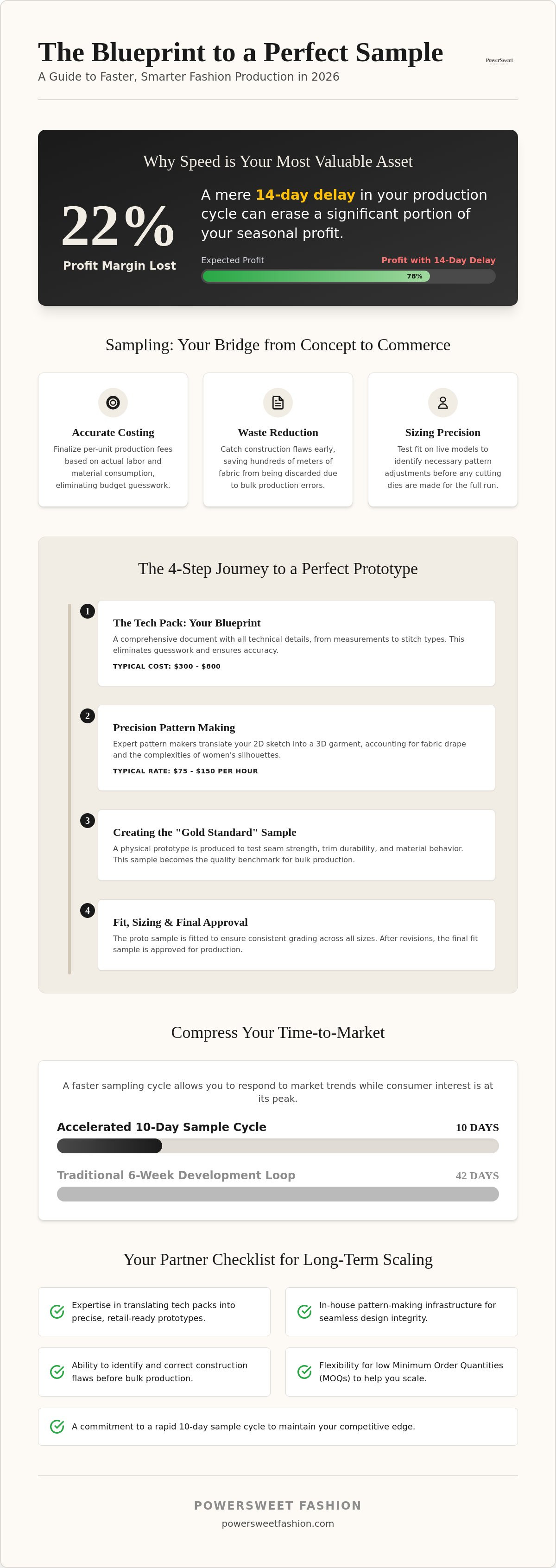
Did you know that a mere 14-day delay in your production cycle can wipe out 22% of your seasonal profit margin? In the fast-paced 2026 fashion market, your choice of a sample development clothing manufacturer isn't just a logistical detail. It is the engine that drives your brand's speed to market. You have likely felt the frustration of receiving a prototype that doesn't match your tech pack or waiting weeks for a sample that still needs multiple revisions. It is an exhausting cycle that drains your budget before you've even sold a single garment.
We believe that manufacturing should be a transparent partnership, not a series of expensive guesses. This guide will show you how professional sample development bridges the gap between your creative vision and a retail-ready product. You'll discover how to secure high-quality prototypes in under ten days and ensure precision in pattern making for diverse sizing. We will also outline the steps for a seamless transition into low-MOQ bulk production so you can scale with confidence and stability. By the end of this article, you will have a clear roadmap to turn your designs into physical reality without the typical industry delays.
Table of Contents
The Strategic Role of a Sample Development Clothing Manufacturer
Sample development is the moment your creative vision meets industrial reality. It's more than just making a single garment; it's a rigorous testing phase that determines if a design is actually manufacturable at scale. A specialized sample development clothing manufacturer acts as your pragmatic partner, translating 2D sketches into 3D prototypes that account for human movement, fabric tension, and production efficiency. This process bridges the gap between a conceptual tech pack and a retail-ready product that customers will actually buy.
This phase is the only reliable way to verify how materials behave after they leave the textile manufacturing process. You might have a beautiful design on paper, but if the fabric drape doesn't align with the pattern or the grainline, the final product will fail on the rack. By testing these variables early, we establish a "Gold Standard" sample. This physical garment serves as the absolute benchmark for quality control during the entire production lifecycle. It ensures every unit in a bulk order matches the approved prototype in construction, fit, and finish.
Risk Mitigation Through Prototype Development
Developing a prototype is a financial safeguard for your brand. Without a physical sample, you risk massive fabric wastage and incorrect sizing across your entire production run. We use this stage to stress-test every element of the garment. This includes testing seam strength and trim durability under real-world conditions to ensure the piece doesn't fall apart after two washes. It's also the best time to verify that grading remains consistent across different sizes.
Accurate Costing: Sampling allows us to finalize per-unit production fees based on actual labor and material consumption.
Waste Reduction: Catching a construction flaw at the prototype stage saves hundreds of meters of fabric that would otherwise be discarded during a bulk error.
Sizing Precision: Testing the fit on live models identifies where patterns need adjustment before the cutting dies are made.
Why Speed in Sampling is a Competitive Advantage
In the 2026 fashion market, speed isn't just a luxury; it's a requirement for survival. Research from OneAim Apparel indicates that a 14-day delay in production can erode up to 22% of a brand's seasonal profit margin. This makes rapid prototyping a critical metric for your brand's growth. If your development cycle is too slow, you'll miss the window for seasonal trends entirely.
We offer a 10-day sample turnaround to help brands iterate faster. This agility allows you to respond to micro-trends and market feedback without getting stuck in a traditional six-week development loop. By compressing your time-to-market, you can launch "drop" models and fresh collections while consumer interest is at its peak. Choosing the right sample development clothing manufacturer turns your supply chain into a responsive tool rather than a slow-moving bottleneck.
The Technical Process: From Tech Pack to Finished Sample
A comprehensive tech pack is your first line of defense against production errors. It acts as the blueprint for your design, containing every technical detail from precise measurements and material specifications to specific stitch types and hardware placements. In 2026, creating a professional tech pack for a small private label run typically costs between $300 and $800, while a full multi-style launch can range from $1,000 to $3,000. Without this document, even a highly skilled sample development clothing manufacturer cannot guarantee that the physical prototype will match your creative vision. We use this data to eliminate guesswork, ensuring that the first sample is as close to retail-ready as possible.
Precision Pattern Making for Women’s Apparel
Translating a 2D sketch into a 3D garment requires an expert pattern maker who understands the complexities of women's silhouettes. Women's sizing involves intricate curves and drape requirements that differ significantly from unisex or men's patterns. Professional pattern making fees in 2026 range from $75 to $150 per hour, reflecting the high level of technical expertise required. Integrating pattern making garment manufacturer services directly into the development phase ensures that design integrity is maintained across all sizes. This early integration prevents the "size distortion" that often occurs when patterns are graded incorrectly for larger or smaller bodies.
Fabric and Trim Sourcing at the Source
Sourcing the right materials during the sampling phase is critical for long-term production stability. We leverage our China-based supply chain to find high-performance textiles and unique hardware that match your specifications exactly. Managing this process end-to-end allows us to verify material availability before you commit to bulk production. Forbes notes that understanding these logistics is a vital part of how to start a clothing business successfully. By securing fabrics during the sampling stage, we avoid the common pitfall of developing a perfect prototype only to find the material is out of stock when you're ready to scale.
The technical process concludes with an iterative feedback loop. Once the first proto sample is finished, we review the construction and fit together. This collaborative approach allows for rapid adjustments to the pattern or material choice. Our goal is to move from your initial concept to a finished, approved sample in under ten days. If you're ready to see your designs take shape with professional precision, you can explore our sample development services to get started. This systematic transition from paper to fabric ensures your brand launches with a product that meets the highest industrial standards.
Navigating Different Types of Samples in the Production Cycle
Sampling isn't a single event; it's a sequence of industrial checkpoints. Each stage serves a specific purpose in refining your product and protecting your financial investment. Understanding these distinctions helps you manage your budget and development timeline more effectively. A professional sample development clothing manufacturer will typically guide you through four primary sample types to ensure your bulk production is flawless and retail-ready.
The journey begins with the Proto Sample. This is the first physical iteration used to test your design and aesthetic concepts. In 2026, a single prototype costs between $200 and $1,000, and most brands require two to three rounds to perfect the look. Next is the Fit Sample, which focuses entirely on sizing and movement. For brands targeting the U.S. market, resources like the CFDA Production Directory provide access to vetted partners who understand these technical milestones. Once the design is locked, you may require Salesman Samples (SMS). These are high-quality versions used for marketing, photography, and trade show presentations. Finally, the Pre-Production Sample (PPS) acts as the final version that must be approved before the bulk machines start.
The Fit Sample: Perfecting the Silhouette
The fit sample is where technical adjustments turn a concept into a wearable garment. During fit sessions, we look for dart placement, hem length, and how the garment reacts to movement. It's critical to use the actual production fabric for these samples because different textiles have unique stretch and recovery properties. To communicate corrections effectively, provide your manufacturer with clear photography of the garment on a live model or form, accompanied by specific technical notes. This reduces the number of revisions and keeps your project on schedule.
The PPS: The Final Quality Gate
The PPS is your last chance to catch errors before mass production begins. This sample must be a 100% accurate representation of the final bulk product. We check everything: garment construction, labels, hangtags, and even the final packaging. Once approved, this becomes the "sealed sample." It's kept as a physical reference for quality control inspections during the bulk run. If the bulk goods don't match the sealed PPS, the factory is held accountable. This system ensures your quality is maintained from the first piece to the last.
How to Choose a Sample Development Partner for Long-Term Scaling
Selecting a sample development clothing manufacturer is a long-term strategic decision that dictates your brand's operational stability. You shouldn't just look for a workshop that can sew a single garment. You need to evaluate their physical infrastructure and technical depth. A reliable partner must have in-house pattern makers and dedicated sampling rooms to ensure that the technical precision established in your tech pack is maintained. Choosing a partner that offers end to end clothing production prevents the logistical fragmentation that often occurs when designers juggle multiple vendors. When the team developing your sample is the same team managing your bulk run, the "Gold Standard" quality remains consistent throughout the entire lifecycle.
Communication transparency is another non-negotiable factor. You should be able to speak directly with the production team rather than through layers of account managers at a trading company. This direct access allows for real-time problem-solving and faster iterations. We act as an authoritative facilitator, providing you with the technical expertise needed to scale without the mystery often associated with overseas manufacturing. By verifying that your manufacturer is a direct factory partner, you eliminate the hidden markups and communication delays that drain your budget and slow your growth.
The Importance of Low MOQ Flexibility
Boutique brands and emerging designers often face the "inventory trap" where high minimums force them to over-buy before testing a trend. This is why partnering with low MOQ women’s clothing manufacturers is a strategic advantage. Starting with a 50-unit test run after the sampling phase allows you to gather actual sales data before committing to a 1,000-unit bulk order. This approach reduces your financial risk and ensures that your capital isn't tied up in unsold stock. Small-batch production provides the flexibility to pivot based on market feedback, which is essential for surviving the rapid shifts of the 2026 fashion cycle.
Verifying Manufacturing Expertise
You must verify that a factory specializes in your specific niche. A manufacturer that primarily handles heavy denim will not have the finesse required for custom women's fashion or romantic lace fabrics. Request past work examples or arrange a video tour of the facility to see their sampling room in action. Look for evidence of precision in their finishing and pattern grading. A direct factory partner will be transparent about their capabilities and will welcome your oversight. If you are ready to secure a partner that combines technical mastery with scalable production, you can contact our team today to discuss your upcoming collection. This level of vetting ensures you are placing your brand in a safe pair of hands.
Accelerating Your Fashion Cycle: The 10-Day Sample Turnaround
A 10-day turnaround is the gold standard for sample development in 2026. This compressed timeline isn't the result of shortcuts; it's the product of a vertically integrated factory structure designed for speed. The logistical breakdown is methodical. Days 1 through 3 are dedicated to pattern drafting and digital grading. Days 4 through 7 involve rapid fabric and trim sourcing from our local supply chain. The final three days focus on precision sewing and internal quality oversight. This speed allows your brand to follow "drop" models and micro-trends while consumer interest is at its peak.
Working with a responsive sample development clothing manufacturer allows you to transition from a conceptual sketch to a physical prototype in record time. This agility directly feeds into your bulk production timeline. Because the technical data is already verified during the 10-day sampling window, we can move into a 15-20 day bulk production cycle without hesitation. Leveraging custom women’s clothing manufacturers for high-speed market entry ensures you stay ahead of the curve in an industry that prizes responsiveness above all else.
Streamlining the Feedback Loop
Digital communication tools have revolutionized how we handle sample approvals and revisions. We use high-definition video consultations to review fit and drape in real time. A dedicated account manager relays your technical feedback directly to the sewing floor to ensure no detail is lost in translation. This direct line of communication reduces the number of sample rounds required. By starting with a high-quality tech pack, you minimize the risk of errors and ensure the first sample is as close to the final vision as possible.
Ready for Bulk: The Seamless Transition
The transition from an approved Pre-Production Sample (PPS) to full-scale production must be seamless to maintain market momentum. We treat the approved PPS as the final blueprint for the bulk machines. This "Gold Sample" stays on the production floor as a constant physical reference for our quality control team. This ensures consistency across every unit, whether you're ordering 50 pieces or 5,000. Finalizing your bulk production fees based on the approved sample construction provides financial clarity and prevents unexpected costs during the final stage of your journey.
Scaling Your Vision with Industrial Precision
Masterful sample development is the foundation of every successful fashion launch. It's the technical phase where your vision becomes a physical reality and your production risks are neutralized. By securing a retail-ready prototype, you establish the benchmark for quality that carries through to your final bulk order. Choosing an expert sample development clothing manufacturer ensures that your patterns are accurate and your fabric choices are tested for real-world performance. This strategic partnership allows you to navigate the complexities of women's apparel construction while maintaining the agility needed to capture emerging trends.
You can launch your collection with 10-day sample development at PowerSweet Fashion. We specialize in women's custom apparel and provide 10-day rapid prototyping to keep your brand moving fast. Our system is built for growth, offering low MOQ bulk production that's ready in 15-20 days. Your creative vision deserves a production engine that is as ambitious as you are. We're ready to help you turn your sketches into a thriving fashion brand.
Frequently Asked Questions
What is the typical cost for sample development at a clothing manufacturer?
In the 2026 garment industry, a single prototype sample typically costs between $200 and $1,000. For a small-batch private label brand, total sampling costs generally range from $800 to $2,000 per style. These fees cover the manual labor involved in pattern drafting, fabric sourcing, and specialized sewing that occurs outside the bulk production line. Some manufacturers may credit a portion of this cost against your future bulk order.
How long does the garment sampling process take from start to finish?
The entire sampling process, from tech pack submission to final approval, typically takes 4 to 8 weeks across the industry. However, a specialized sample development clothing manufacturer can compress this cycle to a 10-day turnaround. This accelerated timeline is achieved by maintaining in-house pattern makers and direct factory access to materials, allowing brands to iterate faster based on real-time market feedback.
Do I need a professional tech pack before contacting a sample manufacturer?
Yes, a professional tech pack is essential before starting the sampling phase. It acts as the technical blueprint for your garment, containing precise measurements, material specs, and stitch details. Without this document, the risk of production errors increases significantly. Incomplete tech packs often lead to multiple rounds of expensive revisions that delay your collection launch and erode your seasonal profit margins.
Can I request samples without committing to a large bulk production order?
You can request samples without an immediate bulk commitment. Most professional manufacturers offer standalone sampling services to help you verify design and fit before scaling. While sampling fees are higher than per-unit bulk costs, this approach allows you to test the market with a physical product. Many partners will credit a portion of these fees against your account once you move into a bulk production order.
What happens if the first sample doesn't match my design specifications?
If a sample doesn't match your specifications, you must provide documented feedback with photography and technical notes. We review these discrepancies against the original tech pack to identify whether the issue lies in the pattern, material, or construction. This iterative loop is a standard part of development. Most brands require two to three rounds of sampling to achieve a retail-ready prototype that meets all quality standards.
Why is sample development more expensive than bulk per-unit production?
Sampling is more expensive because it is a manual, non-automated process. Unlike bulk production, where machines are set up for thousands of identical units, a sample requires a master tailor and pattern maker to hand-cut and sew a single piece. Additionally, sourcing small quantities of fabric and trims for a single prototype carries a much higher per-meter cost than buying materials at a wholesale scale for mass production.
How do I protect my intellectual property during the sampling phase?
You protect your intellectual property by signing a Non-Disclosure Agreement (NDA) before sharing tech packs or proprietary designs. Working directly with a factory rather than a third-party trading company also reduces the risk of design leaks. Maintaining a transparent, B2B partnership with your manufacturer ensures that your creative assets are handled within a secure, professional infrastructure that prioritizes client confidentiality and legal protection.
What is the difference between a proto sample and a pre-production sample?
A proto sample is the first physical version used to test aesthetic concepts and design feasibility. It might use substitute fabrics if the final materials are still being sourced. In contrast, the pre-production sample (PPS) is the final, "sealed" version made using the exact materials and machines intended for bulk production. The PPS serves as the absolute quality benchmark that the factory must match for every unit in the final run.


Comments