%20(1).png)
The Quality Control Checklist Every Fashion Brand Should Use Before Choosing a Clothing Manufacturer

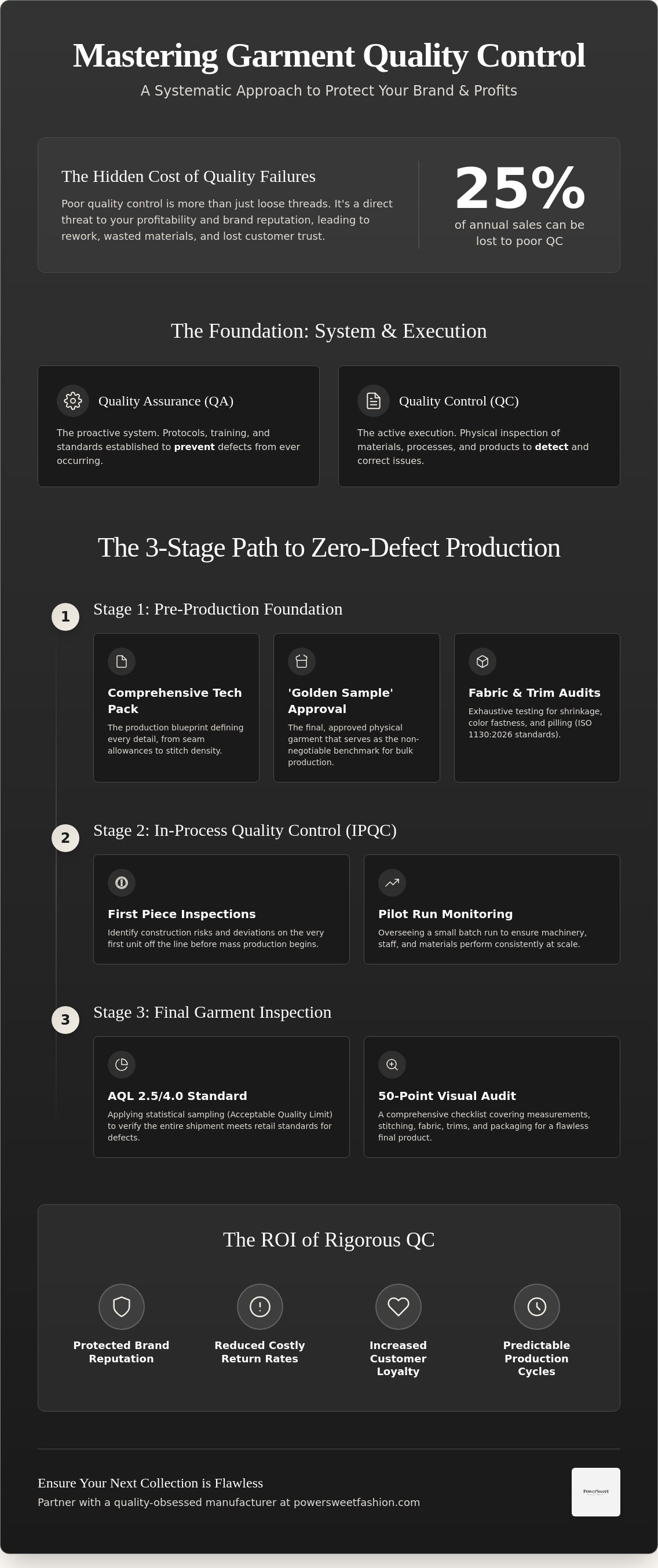
Did you know that poor quality control can cost a fashion brand up to 25% of its total annual sales? It's a staggering figure that represents more than just lost revenue.
It is the cost of a damaged reputation and wasted production cycles.
Finding a reliable quality control clothing manufacturer isn't just about checking boxes at the end of a line.
In 2026, success requires a proactive system that integrates technical precision, fabric sourcing, and compliance with new global standards like the Digital Product Passport.
We know the frustration of receiving a bulk shipment that looks nothing like your approved sample or discovering inconsistent sizing across your latest collection.
You need a manufacturing partner who treats your brand's integrity with the same meticulous care as you do.
This guide will help you master the essential quality control standards and checklists required to ensure your garment production meets professional retail standards every time.
We will preview the specific ISO protocols, PFAS regulations, and systematic inspection steps you need to secure zero-defect shipments and predictable production cycles.
Table of Contents
Beyond the Label: Why Quality Control Defines Your Brand’s Success
Quality control is the pulse of a successful garment business. In the apparel industry, Quality Control (QC) is the systematic process of ensuring every garment meets specific standards for materials, construction, and fit. It isn't a final hurdle to clear.
Instead, it's a continuous commitment that begins long before a needle touches fabric. For a growing brand, the return on investment for rigorous QC is clear.
It protects your margins, reduces return rates, and builds the kind of customer loyalty that fuels long-term growth.
We don't just look for loose threads; we audit the entire production journey to ensure your vision reaches the customer exactly as intended.
As brands scale, they must transition from simple visual checks to comprehensive technical audits.
A startup might get by with a quick look at a finished dress, but a scaling brand needs data-driven results.
This is where the distinction between Quality Assurance (QA) and Quality Control (QC) becomes critical. QA is the system.
It involves the protocols, training, and standards we establish to prevent defects from occurring. QC is the execution.
It is the physical act of inspecting the work on the floor. A professional quality control clothing manufacturer integrates both to create a "safe pair of hands" for your production.
The Hidden Costs of Poor Quality Control
Direct costs are often the most visible. You see the invoices for rework, the wasted fabric materials, and the mounting shipping fees for customer returns.
However, the indirect costs often cut much deeper into your brand's future. Poor quality damages your reputation on social media and can lead to the sudden termination of valuable retail partnerships.
When sizing is inconsistent or seams fail, you lose the trust of your audience.
A 1% defect rate can erode a growing brand's annual profitability by significantly increasing the cost per unit sold once reverse logistics and lost customer lifetime value are calculated.
QC as a Competitive Advantage in Women’s Fashion
Modern consumers have high expectations for durability and fit. They don't just want a garment that looks good in a photo; they want one that performs in their daily lives.
Consistent quality allows you to command premium pricing because your customers know they are paying for reliability.
This trust leads to higher sell-through rates and fewer markdowns. In the world of women's fashion, complex designs and delicate fabrics are the norm.
Maintaining the integrity of these pieces requires strict adherence to Fabric inspection standards before production even starts.
By catching material flaws early, we ensure that the final product reflects the high-end craftsmanship your brand promises.
The Pre-Production Quality Checklist: Sourcing and Sampling
Success in garment production is decided before the first machine starts.
A comprehensive tech pack acts as the primary communication tool between you and your quality control clothing manufacturer.
This document contains every technical detail, from seam allowances to stitch density.
Without a precise tech pack, production becomes a game of guesswork. The "Golden Sample" emerges from this process as your most important legal and technical document.
It is the final, approved version of your garment that serves as the physical contract for bulk production.
If the bulk order doesn't match the Golden Sample, the manufacturer is responsible for the discrepancy.
Professional pattern making is the foundation of consistent sizing. We establish a rigorous "Points of Measure" (POM) list before any fabric is cut.
This POM list provides specific tolerances for every dimension of the garment. By locking in these measurements early, we prevent the sizing deviations that often plague brands as they scale.
It ensures that your grading remains accurate from size XS to XXL, protecting your brand from the negative feedback associated with poor fit.
We don't just hope for a good fit; we engineer it into the pattern itself.
Fabric and Trim Sourcing Audits
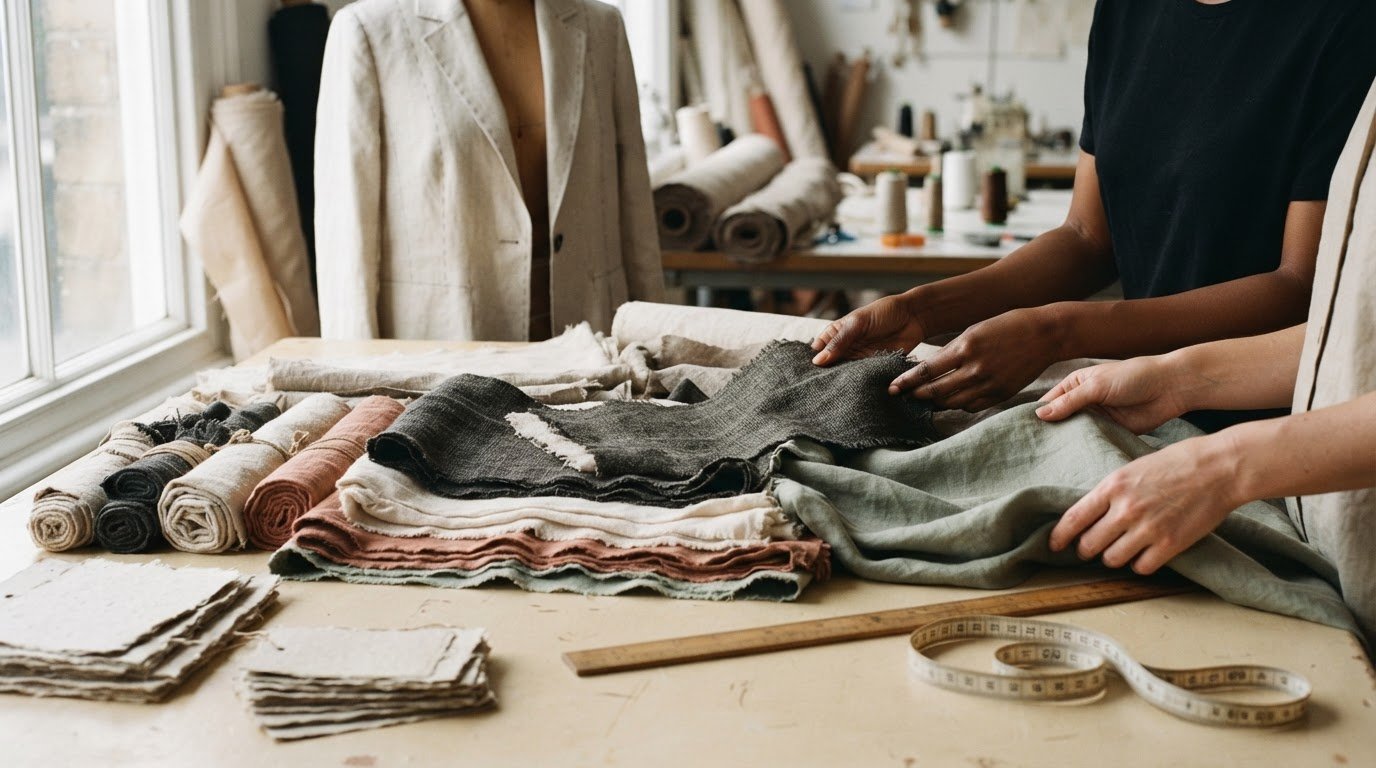
Fabric quality is non-negotiable. We conduct exhaustive testing for shrinkage, colour fastness, and pilling before bulk orders are confirmed.
Our fabric sourcing services include a detailed material QC report to verify these performance metrics.
We utilize modern sampling methods, such as those specified in the updated ISO 1130:2026 standards, to ensure fiber and yarn consistency.
We also verify the quality of trims. Zippers, buttons, and labels must meet strict durability standards. This proactive approach mirrors the rigorous standards found in ISO 9001 quality management systems, focusing on supply chain reliability from the start.
The Sample Development Milestone
The prototype audit is the moment we verify design intent against construction feasibility.
We offer a 10-day sample turnaround that balances rapid speed with meticulous detail verification.
This phase is about more than just aesthetics.
We use the "fit sample" to lock in grading and sizing across the entire range.
If you are ready to move from concept to reality, our team can help you develop professional samples that meet retail standards.
This milestone ensures that every technical hurdle is cleared before the high-stakes phase of bulk manufacturing begins.
In-Process Quality Control (IPQC): Monitoring the Production Floor
Real-time monitoring is the only way to prevent minor errors from becoming bulk catastrophes.
In-process quality control (IPQC) ensures that every stage of the assembly line adheres to the technical specifications established during sampling.
While some brands wait for a final inspection, a professional quality control clothing manufacturer maintains a constant presence on the factory floor.
This proactive approach identifies "construction drift," where small deviations in stitching or alignment begin to appear during high-volume runs.
By catching these issues early, we eliminate the need for costly rework and ensure your production timeline remains on track.
The "First Piece" inspection is the most critical milestone on the production floor.
As the first garments move through the line, supervisors compare them against the approved Golden Sample to verify that every machine setting is correct.
This aligns with the foundational principles of apparel quality control, which emphasize that quality must be built into the garment rather than just checked at the end.
Following this, we conduct pilot run monitoring on a small subset of the order. This identifies potential bottlenecks or construction risks that might only surface when production reaches full scale.
Cutting and Sewing Standards
Precision in the cutting room is the foundation of a perfect fit. If the fabric isn't cut with absolute accuracy, the garment will twist or pull once it's assembled.
We monitor seam strength and stitch-per-inch (SPI) requirements daily to ensure every piece meets retail durability standards.
Our floor supervisors are trained to identify common sewing defects like skipped stitches, puckering, or uneven tension in real-time.
This immediate feedback loop allows operators to adjust their machines instantly, maintaining a high level of consistency across thousands of units.
Workmanship and Construction Audits
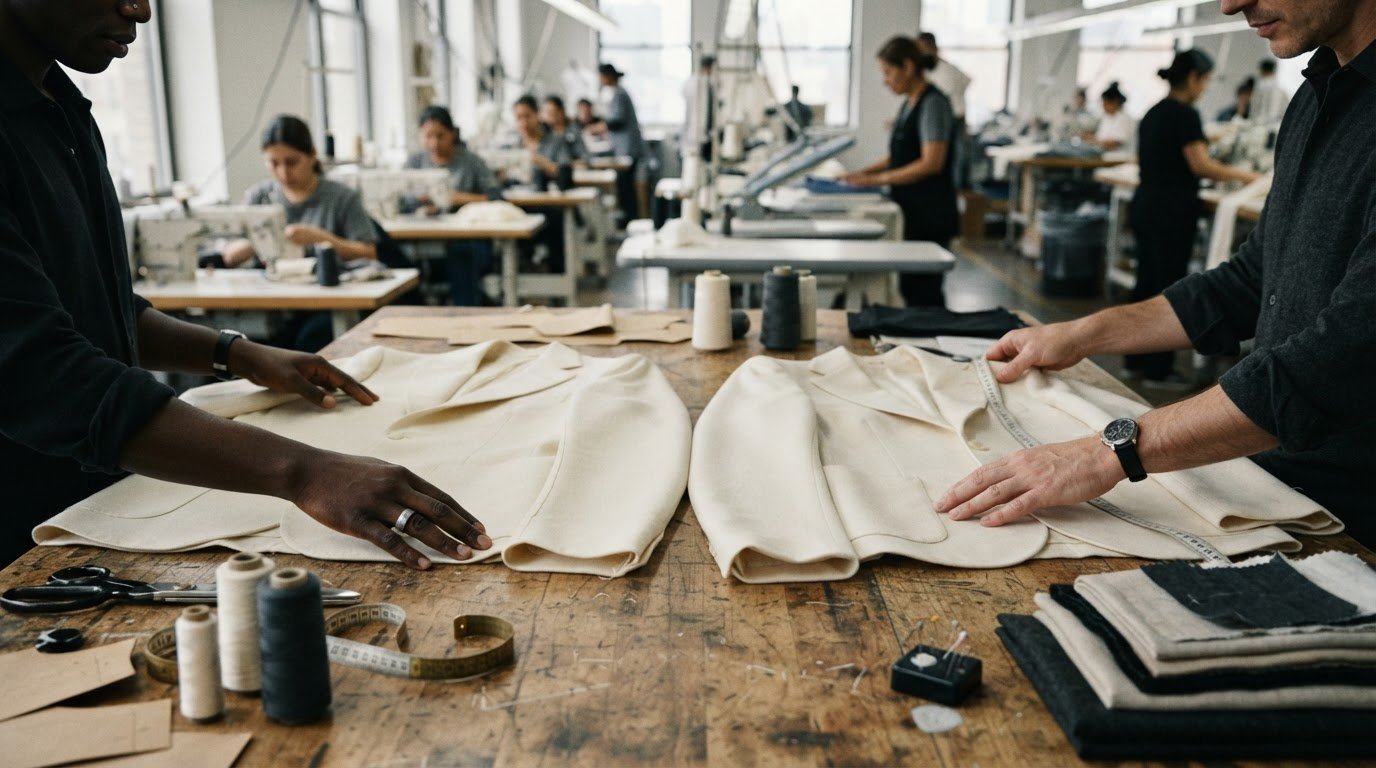
Internal finishing defines the perceived value of your brand. We conduct detailed audits of overlocking, French seams, and lining alignment to ensure the inside of the garment is as clean as the outside.
This includes verifying the placement accuracy for pockets, darts, and decorative elements against the tech pack's measurements.
The integration of automated machinery significantly improves consistency in repetitive construction tasks by removing the variability of manual handling.
These systematic checks ensure that every dart is sharp and every pocket is perfectly level, providing the professional finish your customers expect.
The Final Garment Inspection: A Comprehensive 50-Point Checklist
The final inspection is the gatekeeper of your brand's reputation. It's the last chance to catch an error before the garment reaches a retail shelf or a customer's doorstep.
We implement the AQL 2.5/4.0 standard, which is the global industry benchmark for Acceptable Quality Levels.
This statistical sampling method determines how many garments we must inspect to achieve a high level of confidence in the entire batch.
For example, in a 1,000-unit order, we typically inspect 80 pieces. If the number of major defects exceeds the threshold, the entire lot is rejected for a 100% re-inspection.
This ensures that a reliable quality control clothing manufacturer provides you with data-backed security rather than just a "best effort" promise.
Our measurement audit compares finished garments directly against your tech pack’s spec sheet.
We check every critical Point of Measure (POM) that was established during the sampling phase.
A functional audit follows, where we test the mechanics of the garment. We pull on snaps, cycle zippers ten times, and check the stretch recovery of elastic waistbands.
If a zipper catches or a seam pops under tension, the item fails.
This rigorous testing is especially vital for women's fashion, where draping and fabric hand-feel can be compromised by poor construction.
The Essential Physical Checklist
A visual audit requires a keen eye for details that a machine might miss. We look for symmetry and consistency across the entire production run.
If you're looking for a partner who prioritizes these details, you can explore our quality control services to see how we protect your brand integrity.
Visual: We verify there are no oil stains from machinery, needle holes from rework, or subtle fabric shading variations between different panels.
Symmetry: We match sleeve lengths, collar points, and pocket alignments to ensure the garment hangs perfectly on the body.
Trims: Every button must be securely attached with the correct thread count, and all hardware must operate smoothly without snagging or oxidation.
Packaging and Presentation Standards
Quality control doesn't end when the sewing stops. Packaging is the first thing your customer sees, and it must reflect your brand's value.
We verify label accuracy, ensuring that size tags, care instructions, and country of origin markings are present and correct.
This prevents legal issues and customer confusion during the unboxing process. We also oversee the folding and bagging process.
Garments must be folded to your exact specifications so they arrive retail-ready and wrinkle-free. Finally, we check carton integrity.
We verify weights, dimensions, and shipping marks to ensure your logistics partner can process the shipment without delays or surcharges.
Evaluating Your Manufacturing Partner’s Quality Systems
Choosing the right partner is the most consequential decision you'll make for your brand’s physical reality.
A professional quality control clothing manufacturer operates with radical transparency, inviting you to see the process rather than keeping it shrouded in mystery.
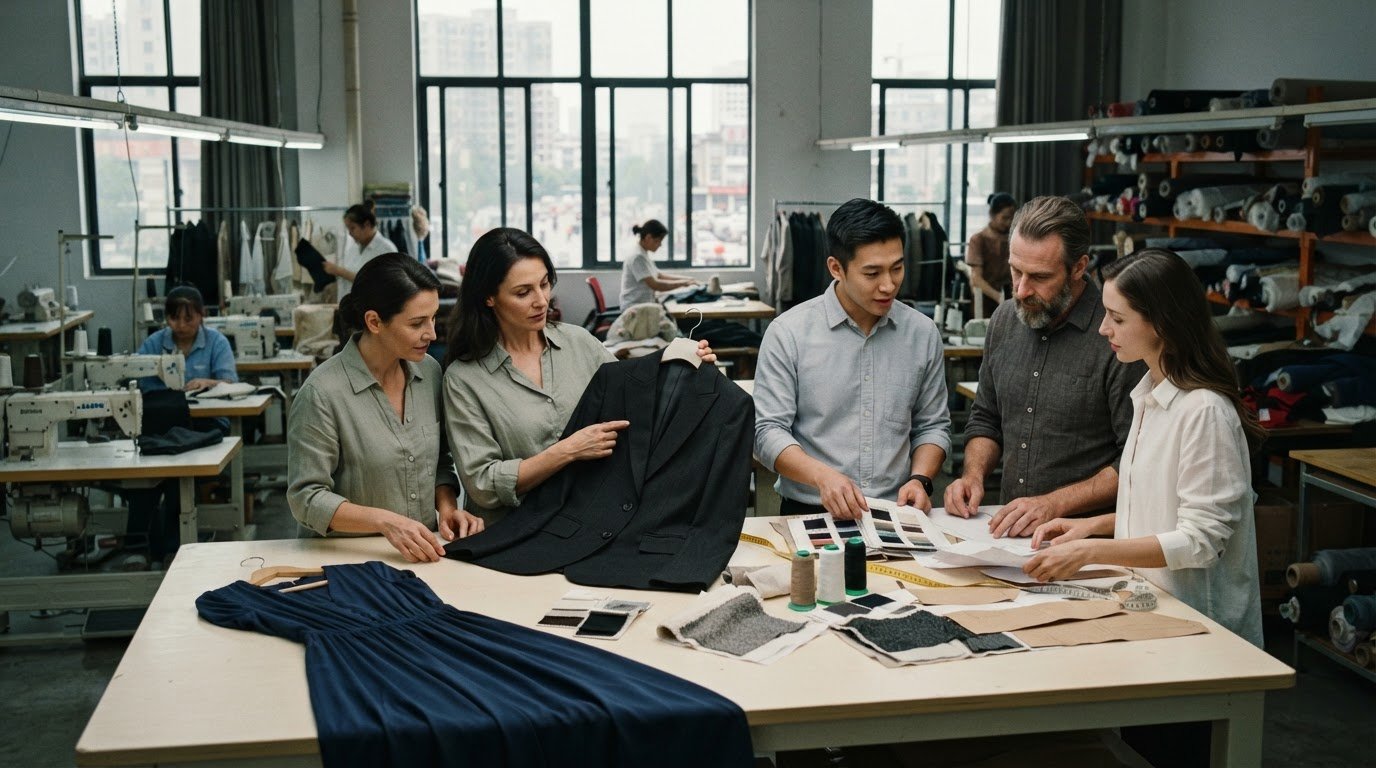
We believe in an "Open Door" policy where clients are welcome to oversee production milestones.
This transparency builds a foundation of trust that digital reports alone cannot provide.
When a manufacturer hides their production floor, they often hide the systemic defects that lead to high return rates.
You deserve a partner that acts as a safe pair of hands for your creative vision.
Communication speed is the true test of a manufacturing partnership.
In a high-stakes production environment, issues will occasionally arise. The difference between a veteran partner and a risky one is how quickly they report and resolve these QC challenges.
You need a team that communicates in real-time, providing solutions before a minor sewing error delays your entire launch.
This responsiveness ensures that your production cycle remains predictable.
It transforms the manufacturing process from a stressful transaction into a collaborative joint venture.
Questions to Ask Your Potential Production Partner
Before signing a contract, you must audit the auditor. Ask your potential production partner about their internal defect rate and how they track it over time.
A partner who can't provide empirical data on their own performance is likely not monitoring it closely enough.
Inquire if they provide a formal QC report before bulk shipment and how they manage fabric sourcing to ensure material consistency across different batches.
These questions reveal whether the manufacturer views QC as a core department or an afterthought.
A reliable partner will have these answers ready, demonstrating their commitment to professional retail standards.
The Power of End-to-End Manufacturing
Errors often occur in the gaps between different service providers. When you work with a custom women’s clothing manufacturer that handles everything from pattern making to bulk production under one roof, these gaps disappear.
This end-to-end integration allows the quality team to reference the original pattern and tech pack instantly.
It significantly reduces the risk of construction drift.
This internal alignment enables us to offer low MOQ options for brands looking to test quality before a full-scale launch.
Our streamlined systems allow us to maintain 15 to 20 day bulk production timelines without sacrificing meticulous QC standards.
By linking every stage of the journey, we provide the grounded, empirical reliability required to scale your brand with confidence.
Secure Your Production Future with Technical Precision
Scaling a fashion brand requires more than creative vision; it demands an industrial partner that prioritizes technical accuracy at every stage.
We've explored how a proactive quality control clothing manufacturer integrates rigorous standards from the initial fabric audit to the final AQL 2.5/4.0 inspection.
By mastering the Golden Sample and maintaining strict in-process monitoring, you eliminate the risks of construction drift and inconsistent sizing.
These systems don't just protect your garments. They protect your brand's reputation and long-term profitability in an increasingly competitive market.
If you're ready to transition from manual checks to a professional, end-to-end production system, we are here to facilitate that growth.
We offer a 10-day sample turnaround and low MOQ flexibility to help you test new designs without overcommitting your budget.
From initial material sourcing to the final retail-ready delivery, we act as a safe pair of hands for your collection.
Our streamlined process ensures your vision reaches the market with total consistency.
Partner with a quality-first manufacturer for your next collection and experience the confidence of zero-defect production.
We look forward to building a reliable, transparent partnership that powers your brand's success.
Frequently Asked Questions
What is the AQL standard in clothing manufacturing?
AQL stands for Acceptable Quality Level. It's a statistical measurement used to determine the maximum number of defects allowed in a batch before it's rejected.
Most apparel brands use AQL 2.5 for major defects. This means the batch passes if the number of flawed items found in a random sample stays below a specific threshold based on your total order quantity.
How do I ensure my manufacturer uses the right fabric?
You must approve a physical swatch and conduct pre-production lab testing for composition and weight.
Every fabric shipment should be accompanied by a material QC report that verifies shrinkage, color fastness, and pilling resistance.
We recommend performing fabric inspection standards before any cutting occurs to catch material flaws at the source rather than after assembly.
What are the most common defects in garment production?
Common defects include skipped stitches, puckering at the seams, and inconsistent sizing across different units.
Visual flaws like oil stains from machines or needle holes from rework are also frequent issues.
A professional quality control clothing manufacturer monitors these daily to ensure every piece meets retail-ready requirements.
This proactive approach prevents construction drift where small errors multiply during high-volume production runs.
Can I perform my own quality control if the manufacturer is abroad?
Yes, you can hire a third-party inspector or request a live video walkthrough of the final audit.
Many brands also require the factory to send "top of production" (TOP) samples for approval before the bulk shipment leaves the facility.
This gives you a physical representation of the final quality without the need for international travel to the factory floor.
How does a tech pack help with quality control?
A tech pack serves as the master technical blueprint that defines every construction detail and measurement.
It includes your "Points of Measure" (POM) and specific tolerances, leaving no room for manufacturer interpretation.
Without this document, your quality control clothing manufacturer cannot objectively verify if the finished garment matches your original design intent.
It's the primary tool for resolving any disputes regarding workmanship or fit.
What should I do if my bulk order has defects?
You should immediately reference your "Golden Sample" and tech pack to document the specific deviations.
Most production contracts include a clause for rework or credit if the defect rate exceeds the agreed-upon AQL limit.
It's vital to report these issues before the goods are sold. This avoids the high costs of customer returns and protects your brand's reputation.
Why is measurement consistency so difficult in apparel manufacturing?
Fabric is a pliable material that can stretch or shrink depending on humidity, tension during cutting, and sewing speed.
Small variations in seam allowances or machine settings can lead to significant sizing differences across a bulk run.
Consistent results require professional pattern making and rigorous in-process checks to keep every garment within the specified tolerances defined in your tech pack.
Is third-party inspection necessary if the factory has its own QC team?
Third-party inspections provide an unbiased perspective that can identify issues the internal factory team might overlook.
While a factory's internal QC is essential for daily monitoring, an external audit offers an extra layer of security for large or high-value orders.
It ensures that the final shipment truly meets your brand's specific quality expectations before it enters your logistics chain.
Comments