
Ways to Plan for Overseas Factory Production Delays

A production delay is any slippage that pushes an order past an agreed production or delivery milestone. Often, the cause is not a factory slowdown but a late material approval, unclear specification, or missed handoff. A practical plan for avoiding production delays with overseas factories makes these risks visible early.
Overseas production can feel less predictable when materials, teams, and shipping are spread across locations. Regular updates and clear checkpoints make uncertainty easier to manage by turning potential problems into issues your team can address.
This guide explains what production delays are, why they happen, and how to plan for them. You’ll learn how diversified sourcing, contingency planning, and milestone tracking can help protect production timelines and keep small problems from becoming bigger disruptions.
Table of Contents
1. What are production delays?
A production delay occurs when materials, approvals, manufacturing, or shipping miss an agreed milestone. For clothing orders, late fabric delivery can hold up cutting, sewing, and delivery. A delay at one stage can affect the wider supply chain, particularly when design, sourcing, and production are handled in separate locations.
Make updates part of the schedule. After agreeing on a shipping deadline, set regular check-ins and ask for progress against specific milestones, such as material arrival, sample approval, and production start. Screen supplier delivery history over the previous 6 to 12 months, then compare promised dates with actual performance. A factory visit can help verify reported progress by letting you observe materials, work in progress, and production capacity.
Coordination needs a clear handoff between each location. Record who approves materials, samples, and specification changes, and share the same dated information with every production partner. ISO 9001 is an international standard for quality management systems, according to the International Organization for Standardization. It describes a management standard, not a guarantee that a particular order will ship on time.
Air freight can cost 3 to 5 times more than ocean freight, so it may help recover time but increases shipping expense. Tariffs and import requirements can affect delivery schedules when documentation or customs clearance is incomplete. Build document preparation and clearance into the shipment plan, rather than treating arrival at the port as final delivery.
For factory completion, allow at least 60 days for an overseas order, then add schedule flexibility for material sourcing, approvals, and transport. Contract terms can set milestone dates, update responsibilities, written approval procedures, and notice steps if a deadline slips. Use a binding agreement with vetted factories and define how approved design files are protected.
Quality checks can catch problems before they create rework. Before production, inspect raw materials or components and provide a reference sample for comparison. Schedule an independent mid-production inspection, then a pre-shipment inspection when at least 80% of the order is complete. These checkpoints help identify defects while there is still time to correct them.
2. Contingency planning and sourcing diversification
A backup plan works best before a shipment is at risk. Map each order’s critical materials, production location, and next available sourcing option. Brands may plan production runs as far as 2 years in advance, giving teams time to reserve capacity and identify single-source dependencies. For apparel, that means checking whether an alternate supplier can access the approved fabric, trims, and specifications without changing the product.
Diversify deliberately. A China+1 strategy spreads production across countries or regions, reducing reliance on one location as a single point of failure. You can also qualify a second supplier for a critical material or product. Keep the approved specifications and sample standards consistent, then decide in advance which orders or components could move if a supplier faces disruption. Splitting every order across suppliers can add coordination work, so match the backup approach to the order’s risk and complexity.
Compare planned and actual progress against the same milestones. In an ERP or MRP system, keep order quantities, material requirements, planned dates, and completion status aligned. Review exceptions, such as materials without confirmed supply or a production phase falling behind schedule. A shared record helps purchasing and production teams work from consistent information instead of separate spreadsheets.
Seasonal orders need a contingency that accounts for demand timing. High-velocity and seasonal products should have 8 weeks of safety stock as a baseline. Use sales patterns and order commitments to decide which styles need that reserve, then set a replenishment trigger before stock falls too low. Avoid treating extra inventory as the only fallback; alternate sourcing and reserved production capacity can also protect a launch.
For clothing orders, coordinated fabric sourcing can connect material selection with production planning. Build the contingency around the fabric’s availability, approved specifications, and the shipment date, so a sourcing challenge has a defined next step rather than an improvised response.
3. Manufacturing milestones and lead-time monitoring
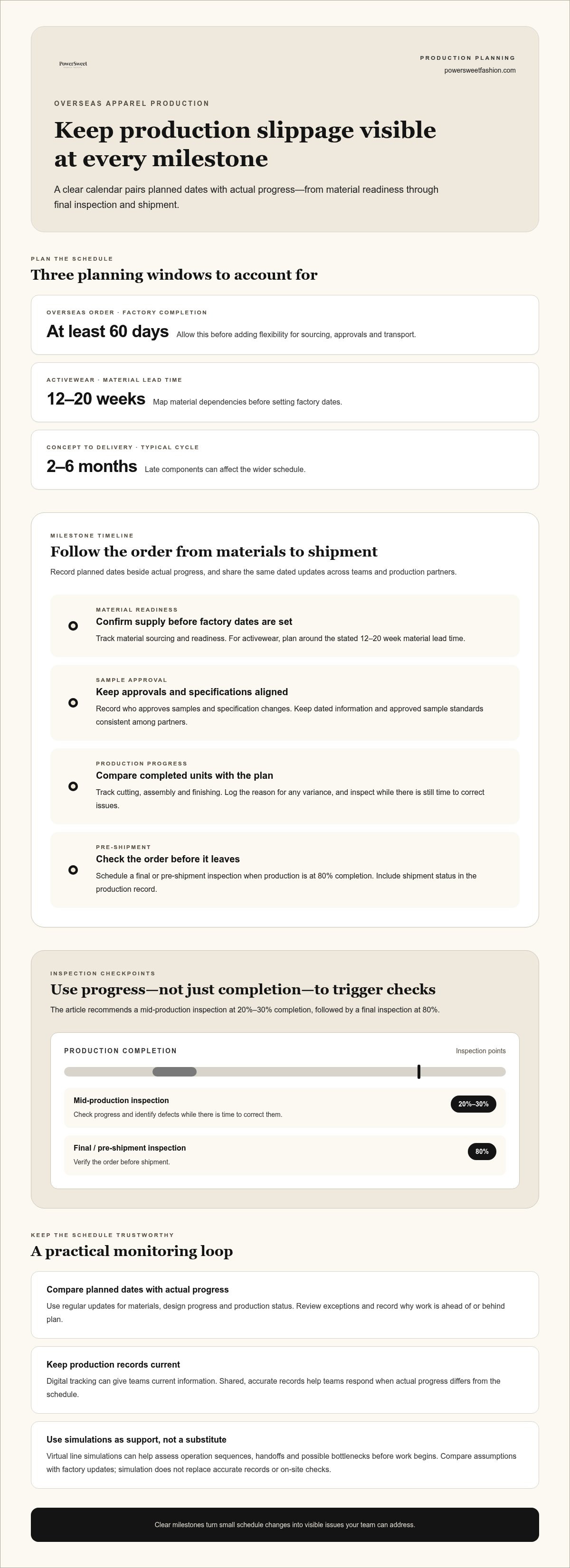
A production calendar is useful only when it shows planned dates beside actual progress. Record material readiness, sample approval, cutting, assembly, finishing, and shipment milestones. For activewear, allow 12 to 20 weeks for material lead times, and map that dependency before setting factory dates. A typical concept-to-delivery cycle spans 2 to 6 months, so late components can affect the entire schedule.
Monitor production at two or more stages, not just at completion. A mid-production inspection is recommended when manufacturing reaches 20% to 30% completion, while a final inspection is recommended at 80%. Between checkpoints, compare units completed with the plan and log reasons for any variance. Digital tracking can give teams current information on material sourcing, design progress, and production status, helping them act on changes sooner.
Virtual manufacturing-line simulations can help teams assess how a proposed sequence may flow before work begins. Map each operation, component handoff, and potential bottleneck, then compare the model with factory updates. Revise assumptions when actual progress differs. Simulation supports planning, but it does not replace accurate production records or on-site checks.
Coordinating design, sourcing, and manufacturing through one manufacturer can reduce the number of handoffs and make it easier to keep specifications and schedule updates aligned. For changing trends, flexible production can also help brands respond to emerging styles or social movements instead of committing every design to a large advance run.
Production monitoring examples report a factory first-pass rate of 95.2 percent. First-pass rate tracks the share of products meeting requirements without rework, making it a useful companion to milestone status. Review both measures together: a line can appear on schedule while rework threatens final delivery. Use the record to identify the stage, components, and decision that need attention, then adjust the next production step.
4. Causes of production delays
Delays often start with decisions made before the sewing line begins. In one knit ladies’ T-shirt order of 73,890 pieces, metal button approval took 9 to 15 days, while styling sample approval took 8 to 18 days. Those approvals pushed shipment back by 45 days. The production process depends on timely decisions: late specifications, unclear changes, or slow sample feedback can hold up materials and factory work.
Capacity creates another risk. A factory already operating at 90% capacity has little room to absorb equipment issues, staff shortages, or an urgent change without affecting timelines. Ask for production status against agreed milestones, and record what is complete, what is blocked, and the next action. Limited visibility can mean a buyer learns about a delay only after the original schedule is difficult to recover.
Quality issues add time through rework. Poor-quality sample submissions that require correction can add up to 22 days to production schedules. To reduce avoidable revisions, document every approved design change and share one current specification with the people making the garments. Clear records help prevent conflicting instructions from reaching sampling, cutting, and assembly teams.
Seasonal closures and order size also shape schedules. Many factories and businesses, especially in China and Vietnam, close for three weeks or more during Lunar New Year. High minimum order quantities can also delay apparel deliveries if a brand must wait for a large production run to finish. Build these constraints into the plan before committing to a launch date.
Port congestion, customs holds, or a missed production slot can extend the time between factory completion and delivery. Update the arrival forecast as soon as a shipping handoff slips, then assess whether inventory or launch plans need adjustment. Recording the cause and its effects helps teams respond to the actual disruption instead of treating every delay as a factory problem.
For clothing projects, plan your custom production with clear specifications and approvals at each stage.
PowerSweet Fashion: Custom Women's Clothing Production
PowerSweet Fashion supports apparel brands with coordinated development and production for women's clothing. Its services include Sample Development, Fabric Sourcing, Custom Women's Clothing Production, and Quality Control Services, helping teams connect product decisions with manufacturing steps.
Turn to PowerSweet Fashion when you’re planning a new clothing order and want support from sample development through production. Samples are ready in 10 days, and bulk production takes 15-20 days. Clear specifications and timely approvals help keep each stage aligned with the production plan.
If you’re preparing an order or refining a production plan, contact PowerSweet Fashion to discuss your project.
Make your next production plan more resilient
A durable approach to avoiding production delays with overseas factories starts with decisions made before an order begins. Treat each collection as a chance to refine your process: note what slowed approvals, where handoffs became unclear, and which updates helped your team respond. Carry those lessons into the next production plan so improvements build over time.
PowerSweet Fashion supports the next step with Custom Women's Clothing Production, Sample Development, and Fabric Sourcing. These services connect product development with manufacturing. Share your design direction and production priorities with the team to discuss support for your upcoming order.
Contact PowerSweet Fashion to discuss your next clothing production project. With a clearer plan and the right production partner, your team can move forward with greater control and confidence.
Frequently Asked Questions
What are production delays?
A production delay is a missed planned date that affects a later step or the order’s delivery. For example, if a garment cannot move from cutting to sewing because a required component has not arrived, the schedule has slipped even if sewing has not started. Track the affected operation and downstream dates separately to see whether the issue threatens the launch or only one production task.
What are the most common causes of production delays at overseas factories?
Delays commonly stem from late approvals, unavailable materials, capacity constraints, quality problems that require rework, and transport disruptions. Even a small approval issue can have wider effects: changing a button or fit detail may require a revised sample before bulk production can proceed. To identify the underlying cause, record when the issue began, which process it affects, and what decision or component is blocking progress.
How can companies vet overseas manufacturers for production reliability?
When avoiding production delays with overseas factories, assess how a manufacturer manages work, not just its delivery promise. Review its delivery record, discuss how it reports schedule changes, and compare available capacity with your order’s requirements. A factory visit can show how work moves between stations and whether updates reflect progress on the production floor. Agree on written specifications, approval steps, and update expectations before production begins.
What lead times should buyers expect from overseas factories by country and industry?
Lead times depend on the product, material availability, sample approvals, factory capacity, production sequence, and shipping route, so country alone doesn’t determine the schedule. A typical concept-to-delivery cycle spans 2 to 6 months; activewear materials may require 12 to 20 weeks. Allow at least 60 days for an overseas factory order, then plan backward from the required arrival date and account for each handoff.
How can buyers monitor production progress at an overseas factory?
A practical part of avoiding production delays with overseas factories is keeping a progress record tied to the order’s specifications. Each update should identify completed work, pending operations, material or approval blockers, and the next production step. Compare quantities completed with the current plan, and keep dated records of changes. If remote updates leave unanswered questions, a factory visit or independent monitoring can clarify actual work in progress.
What backup plans can companies use when an overseas factory misses a deadline?
First, identify the cause and which order stages can still recover. Then consider shifting an eligible component or future order to an alternate source, using reserve stock, or adjusting launch allocations to prioritize time-sensitive styles. For example, a brand could protect committed orders while delaying replenishment. Keep approved product specifications and material details organized so a contingency can be activated without restarting development.

Comments