
What Supply Chain Safety Means and How to Protect Workers

A safe supply chain is built long before a garment reaches the cutting table. Protecting workers means looking beyond the finished product to the conditions, practices, and risks at every stage of production. If you’re considering how to ensure worker safety in your supply chain, make safety part of procurement, provide training workers can understand, and monitor supplier practices over time.
Clear standards matter, but they work best when suppliers and buyers communicate openly and address problems as they arise. A practical approach to how to ensure worker safety in your supply chain connects expectations with everyday production decisions. This article explains what supply chain safety covers, how procurement can set expectations, why accessible training matters, and how supplier monitoring can help identify risks. You’ll gain a clearer framework for protecting the people behind production.
Table of Contents
1. Including safety and employment injury protection in procurement
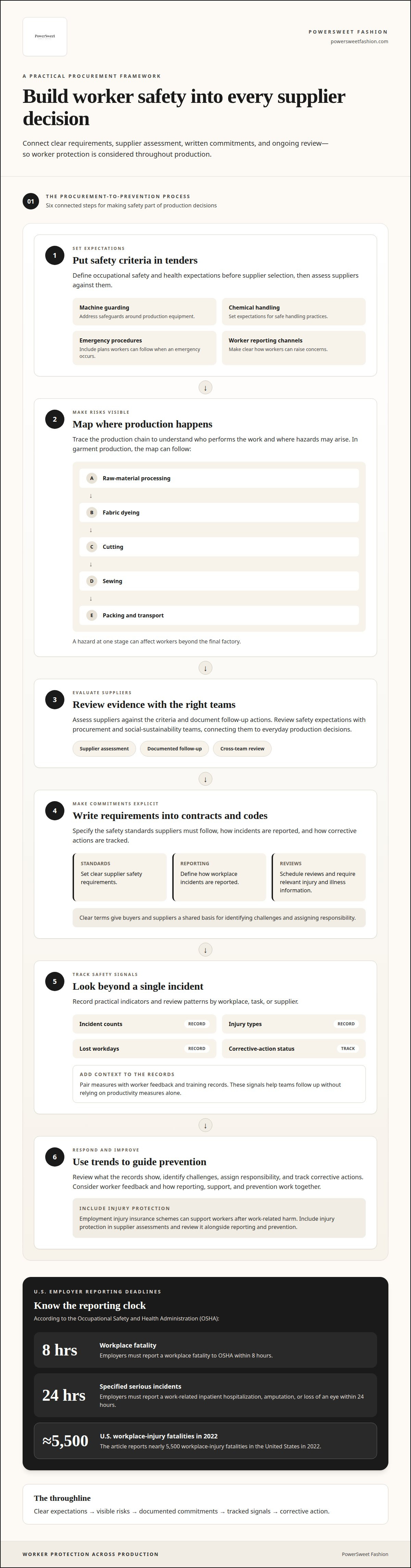
Procurement makes worker protection part of supplier selection, rather than an afterthought. Set clear occupational safety and health criteria in tenders, assess suppliers against them, and document follow-up actions. For garment production, criteria can address machine guarding, safe chemical handling, emergency procedures, and workers’ access to reporting channels. Connect those requirements to production decisions and review them with procurement and social-sustainability teams.
Contracts and codes of conduct should specify the safety standards suppliers must follow, how incidents are reported, and how corrective actions are tracked. Include scheduled reviews and require suppliers to share relevant injury and illness information. Clear terms give employers and buyers a shared basis for identifying challenges, assigning responsibility, and improving workplace practices during production.
Workplace injuries can have severe consequences: nearly 5,500 workplace-injury fatalities occurred in the United States in 2022. In the United States, employers must report a workplace fatality to OSHA within 8 hours, according to the Occupational Safety and Health Administration. Employers must report a work-related inpatient hospitalization, amputation, or loss of an eye to OSHA within 24 hours, according to the Occupational Safety and Health Administration.
Recording injuries and work-related illnesses helps companies identify patterns that a single incident can hide. Track incident counts, injury types, lost workdays, and corrective-action status; review trends by workplace, task, or supplier. Pair these measures with worker feedback and training records. This gives procurement teams practical signals for follow-up without relying on productivity measures alone.
Employment injury insurance schemes can support workers after work-related harm, while occupational safety policies and good business practices contribute to Sustainable Development Goal 3 on universal health coverage and Sustainable Development Goal 8 on decent work and economic growth. Include injury protection in supplier assessments, then review how reporting, support, and prevention work together. That step links procurement requirements to the workforce’s health and security.
2. What is Supply Chain Safety?
Supply chain safety means protecting workers’ health across every stage of making and moving a product. It includes direct employees and workers employed by suppliers or other business partners. In clothing production, risks may arise during raw-material processing, fabric dyeing, cutting, sewing, packing, or transport. A hazard at one stage can affect workers far beyond the final factory. Worldwide, 2.78 million workers die each year from work-related accidents and diseases, showing why protection must extend across production relationships.
Supply chain relationships shape safety through purchasing schedules, production requirements, and management practices. A buyer’s deadlines can influence how a supplier plans shifts and tasks, while clear expectations and communication can support safer decisions. Mapping the chain helps organizations understand where work happens, who performs it, and what hazards may be present. For a garment, a map might trace fabric to its processing site, then follow cutting, sewing, and finishing. This makes hidden risks easier to locate and gives teams a practical basis for prevention.
National occupational safety and health systems provide the framework for workplace protections. In the United States, the Occupational Safety and Health Act of 1970 created OSHA, which sets and enforces protective workplace safety and health standards, according to the Occupational Safety and Health Administration. National systems vary, but laws, inspections, education, and reporting channels can each support worker health and safety. Businesses operating across borders need to understand local conditions and maintain responsible practices throughout their supplier relationships.
Worker health is operational infrastructure, not a separate concern. Unsafe equipment, repetitive motions, chemical exposure, or poor emergency access can disrupt production and harm people. Organizations can connect safety information to daily operations by reviewing incident reports, worker feedback, task changes, and production processes together. For example, an increase in reports of discomfort at a sewing station can prompt a review of posture, equipment layout, and breaks. This helps turn reporting into practical prevention and makes health part of routine production planning.
3. Safety training in a language workers understand
Training works only when workers can understand and apply it. Employers should deliver safety instruction in a language workers understand, then demonstrate procedures using the equipment they work with. For garment work, this could mean showing how to operate a cutting machine, handle fabric safely, or respond to a machine fault. Ask workers to explain or demonstrate key steps so instructors can identify gaps and clarify instructions.
Suppliers should provide initial equipment-use training and regular continuing education on safety protocols. A useful program covers hazard recognition, safe work procedures, emergency response, injury reporting, and the correct use of protective equipment. Training should also explain how workers can raise concerns, making reporting part of workplace culture rather than an afterthought.
Heat stress and air quality call for practical instruction alongside monitoring. Workers should know how to recognize heat-related warning signs, follow site procedures, and report concerns promptly. Supervisors can use air-quality monitoring results to identify changing conditions and communicate relevant precautions before tasks begin. For example, if production moves near a chemical-use area, workers need clear instructions about exposure controls and where to report symptoms.
Work changes, so training must keep pace. When workers move to a new role, use different machinery, or encounter a changed process, employers should explain task-specific hazards and demonstrate safe methods before work starts. Follow-up training reinforces procedures and helps supervisors spot misunderstandings. This ongoing approach supports safer working conditions as production needs shift.
Training also has an operational case: companies with robust safety training protocols experience nearly one-third lower costs than companies without them. A consistent program can help reduce avoidable injuries and disruption while strengthening safety culture. Employers can track completion, worker understanding, and reported hazards, then use the results to improve training and direct resources where monitoring identifies gaps.
4. Monitoring supplier compliance and addressing identified risks
A supplier monitoring program should identify worker hazards and turn findings into tracked corrective action. Combine regular site visits, performance reviews, worker feedback, and production records rather than relying on a single assessment. For garment manufacturing, reviews can examine machine safeguards, chemical storage, emergency exits, injury reports, and workers’ access to complaint channels. Assign responsibility for each finding, set a follow-up date, and record whether the change reduced the risk.
A comprehensive review should cover environmental, social, and governance risks alongside operational performance. Check for labor concerns such as unsafe conditions, excessive pressure, or barriers to reporting. Review whether production changes, missed schedules, or equipment problems are linked to hazards or accidents. Geographic data and worker surveys can help identify risks deeper in the chain, including climate-related hazards that may affect working conditions or disrupt a site.
Audit costs depend on scope, supplier locations, review depth, and follow-up needs; pricing is provided after a quote request. A workplace safety audit should examine physical conditions, safety procedures, training records, incident reporting, worker feedback, and progress on earlier findings. Site observations and confidential worker conversations can add context to written records. The review should also consider emergency arrangements and how suppliers manage environmental or natural-disaster risks.
Social audits offer useful evidence, but a single visit cannot cover every shift or capture every worker’s experience. Workers may hesitate to raise concerns, and documents alone may not reflect daily practice. Reduce these gaps by combining audits with ongoing dialogue, repeated visits, performance data, and confidential reporting channels. Apply the same process to ethical and compliance risks, then prioritize actions according to potential harm and urgency. Monitoring should support supplier improvement, not end with a completed checklist.
Costs vary by review scope, supplier locations, depth, and follow-up needs; pricing is provided after a quote request.
PowerSweet Fashion
PowerSweet Fashion supports fashion brands that incorporate worker-safety expectations into production planning. If your requirements affect fabric selection, garment construction, or inspection criteria, include them in the production brief from the start. Fabric sourcing, sample development, custom women’s clothing production, and quality control can support a more transparent workflow, with requirements considered at relevant stages rather than left until finished garments are reviewed.
This is a practical next step when you’re developing a women’s clothing line and need production processes aligned with your standards. Share the specifications and quality expectations that matter to your project so they can inform development and production decisions. Contact PowerSweet Fashion to discuss your clothing production needs.
Turn Your Safety Standards Into Production Decisions
Make worker protection part of how each production project is defined and managed. Translate your expectations into clear project requirements, then keep them connected to decisions about materials, garment development, and production quality. Use those priorities to guide how to ensure worker safety in your supply chain at each stage.
For fashion brands, those requirements can inform fabric sourcing, sample development, and custom women’s clothing production. PowerSweet Fashion can support these parts of the production process, helping you align project specifications with your quality expectations. A clear project brief is one practical way to consider how to ensure worker safety in your supply chain. Contact PowerSweet Fashion to discuss your next project. A thoughtful start can help turn worker-safety priorities into a more responsible production approach.
Frequently Asked Questions
What is Supply Chain Safety?
Supply chain safety means protecting people from work-related hazards across the businesses and processes involved in producing and delivering goods. In a clothing chain, that can include workers handling chemicals during fabric processing, operating cutting equipment, sewing garments, or moving finished orders. The practical test is whether safety considerations extend beyond a buyer’s direct workplace to the production relationships and tasks that contribute to each product.
What are the main worker safety risks in supply chains?
Common risks include unsafe machinery, chemical exposure, heat, poor air quality, repetitive movements, and extended uncomfortable working positions. Hazards depend on the task: fabric processing may involve chemicals, while sewing can involve repeated motions and prolonged sitting. Workers in isolated roles may also face environmental hazards or violence. Consider each site’s processes and conditions rather than assuming every supplier faces the same risks.
How can companies assess worker safety risks among suppliers?
Start by tracing where materials are processed and where each production step takes place. Then consider the work performed at every mapped site, including chemical use, equipment operation, repetitive tasks, and emergency access. Combine location and process information with worker feedback and incident patterns. This helps companies prioritize closer review where hazards could be more severe or workers have fewer ways to raise concerns.
How can companies verify supplier compliance with worker safety requirements?
Go beyond a policy document. Review relevant records, observe work practices during site visits, speak with workers, and follow up on previous findings. Compare what workers describe with the conditions and procedures observed on site. Record each concern, the agreed corrective action, and later evidence of progress. Repeated checks help reveal whether requirements are followed in everyday production, not just presented during an assessment.
What steps should companies take when they find unsafe conditions at a supplier?
First, establish what the hazard is, who could be affected, and whether work needs immediate protective action under the site’s procedures. Record the finding and agree with the supplier on a corrective measure, a responsible person, and a follow-up review. Check that the change addresses the cause, not just the visible symptom. For example, recurring machine-related injuries call for reviewing safeguards and work practices, not merely documenting each incident.
How can workers report safety concerns safely and without retaliation?
Provide a clear reporting channel workers can access privately, explain how concerns will be handled, and make reporting available in languages they understand. In the United States, workers may report workplace safety concerns without being punished or treated unfairly, and may file a confidential OSHA complaint about unsafe or unhealthy conditions. According to the Occupational Safety and Health Administration, a worker alleging retaliation for exercising OSHA rights can file a whistleblower complaint within 30 days of the retaliation.


Comments