%20(1).png)
How to Choose a Premium Dress Manufacturer That Delivers Luxury Quality
- Powersweet Team

- Jul 18
- 11 min read
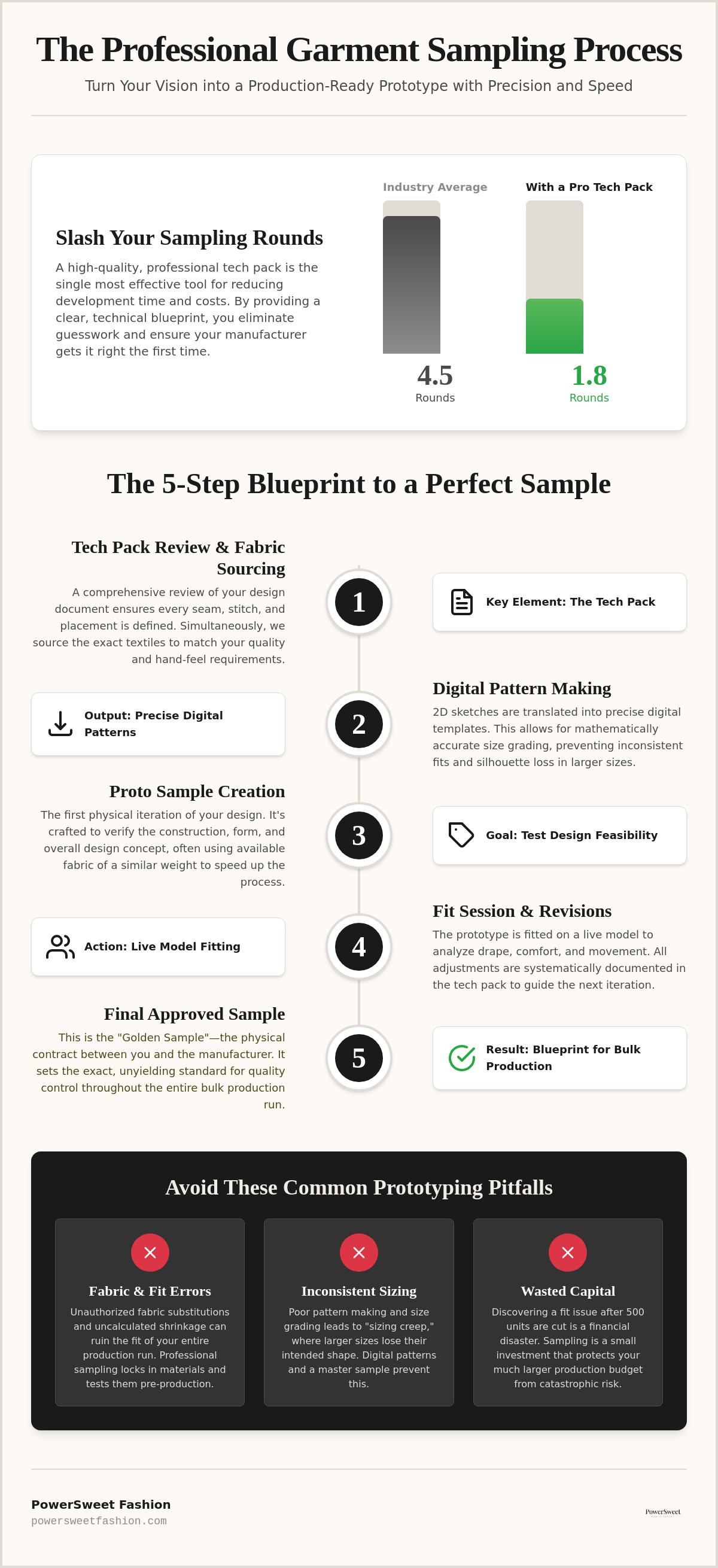
A high-quality tech pack can reduce your sampling rounds from an average of 4.5 down to just 1.8, yet many brands still struggle through five or more iterations with their dress manufacturer before a single garment is retail-ready.
It's exhausting to deal with inconsistent sizing and slow turnaround times that push your launch dates further into the future.
You likely feel that every day spent in the sampling phase is a day your capital is tied up in development rather than sales.
This guide will show you how to turn your vision into a production-ready prototype in under 14 days.
You'll learn the exact step-by-step process of garment sample making to turn your designs into retail-ready collections with precision.
We'll explore the technical requirements for a perfect fit and finish, providing you with a scalable blueprint for bulk manufacturing that matches your original design vision from the very first stitch.
Table of Contents
What is Garment Sample Making and Why It Matters for Dress Manufacturers?
Garment sample making is the critical transition from a 2D technical design to a 3D physical product.
It's the moment your vision meets the reality of the factory floor. For a professional dress manufacturer, this phase isn't a luxury; it's a technical audit. Skipping or rushing this stage often results in costly production errors that can bankrupt a collection before it ever reaches the retail shelf.
We treat the sampling phase as the foundational blueprint for your entire brand's reputation.
Skipping professional sampling before bulk production is a high-risk gamble.
If a fit issue is discovered after 500 units are cut, the financial loss includes wasted raw materials, labor hours, and missed shipping windows.
For a growing brand, these setbacks are often insurmountable. We view sampling as an investment in stability.
It provides the empirical data needed to confirm that the fabric weight, seam strength, and finishing techniques meet luxury standards before you commit your full budget to the factory floor.
Research indicates that a high-quality tech pack can reduce these sampling rounds from an average of 4.5 down to just 1.8, significantly cutting your development costs.
The Purpose of the Prototype
Testing design feasibility is the primary goal of the initial prototype. You need to know if the aesthetic appeal translates to a wearable garment that moves with the body.
This stage uncovers construction challenges, such as seams that pull or necklines that don't lay flat, which are impossible to detect on a digital screen.
A Proto Sample is the first physical iteration of a tech pack, created to verify the initial design concept using available fabrics.
Sampling as a Scalability Test
Efficiency is the heartbeat of profitable manufacturing. Sampling allows us to analyze the production journey for each garment by calculating the exact minutes required for sewing and finishing.
If a specific design detail adds excessive time to the production cycle, we can adjust the pattern early to maintain your profit margins.
This stage heavily relies on technical Pattern making; this process ensures that the transition from a sample size to a full production run is seamless and accurate.
The final approved sample serves as the physical contract between you and your dress manufacturer, setting a clear, unyielding standard for every quality control inspection that follows.
The 5-Step Process of Professional Garment Sample Making
Every professional dress manufacturer follows a chronological workflow to eliminate ambiguity and protect your margins.
We start with a comprehensive technical review of your design.
This document acts as the instruction manual for producing a fashion garment, ensuring every seam allowance, button placement, and stitch type is clearly defined. Simultaneously, we execute fabric sourcing.
We identify the exact textiles that match your hand-feel and weight requirements, often sourcing directly from specialized markets in Guangzhou to ensure quality and availability.
From Tech Pack to First Pattern
Modern production facilities utilize digital pattern making to translate your 2D sketches into precise geometric templates.
This software allows us to grade sizes with mathematical accuracy, preventing the common issue of "sizing creep" where larger sizes lose their intended silhouette.
Accuracy at this stage is non-negotiable.
A flawed pattern leads to wasted fabric and inconsistent fit during bulk production, so we prioritize precision before the first piece of cloth is ever cut.
Once the pattern is digitized, we create the Proto Sample.
This is your first look at the garment's physical form.
It's often made with "available" fabric of a similar weight to test the construction without waiting for custom-dyed materials.
Following this, we enter fit sessions to refine the drape and movement of the piece.
Working with an experienced dress manufacturer ensures that these technical revisions are handled systematically rather than through guesswork.
The Importance of Fit Samples
You should always conduct fit sessions on a live model who matches your target demographic's measurements.
While a dress form is useful for static checks, a human model reveals how the fabric behaves when the wearer walks, sits, or reaches.
We document every adjustment directly in the tech pack. Clear, data-driven communication here is vital for a successful collection.
If you're currently vetting production partners, reviewing Mastering Sample Development can help you identify a factory with the necessary technical expertise.
The final stage is the Pre-Production Sample (PPS), also known as the "Golden Sample." This version uses the exact production fabric, trims, and labels.
Approval of the PPS is the official green light for the factory to begin bulk cutting.
If you're ready to move your designs from the drawing board to the runway, our team at PowerSweet Fashion provides the end-to-end support needed to navigate this journey with confidence.
Technical Requirements: Tech Packs and Pattern Making for Dresses
A design sketch is a creative vision, but a technical illustration is a production command.
Every dress manufacturer requires precise technical data to avoid costly guesswork on the factory floor.
While a sketch conveys the "mood" of a garment, the technical illustration provides a flat, proportional view of every seam, stitch, and hardware placement.
This level of detail is the only way to ensure the physical sample matches your original intent.
High-quality documentation is a proven efficiency driver; a professional tech pack can reduce sampling rounds from an average of 4.5 down to just 1.8 iterations.
One critical element often overlooked during the sampling phase is the integration of fabric sourcing.
The physical behavior of a garment is dictated by its material. For example, the drape of a 160gsm basic cotton differs significantly from a 200gsm premium ringspun cotton.
If the pattern is developed without the final production fabric in mind, the silhouette will fail during bulk manufacturing.
We prioritize early fabric identification to ensure that the pattern making accounts for specific textile properties like stretch recovery and weight.
Components of a High-Quality Tech Pack
The Bill of Materials (BOM) is the heartbeat of your tech pack.
It must list every single component, from the primary fabric and lining to the specific brand of zippers and the weight of the thread.
Measurement specifications are equally vital.
You must provide a "points of measure" (POM) chart that defines the exact dimensions for every size in your range.
Clear construction callouts, such as "twin-needle topstitching" or "hidden French seams," guide the sewing team to execute luxury-level finishes without constant back-and-forth communication.
Pattern Making for Complex Dress Silhouettes
Complex designs like bias cuts, intricate pleats, or sculptural tiers require advanced technical expertise.
Professional pattern makers translate these creative ideas into 2D templates that manage fabric tension and grainlines effectively.
This process has shifted from traditional paper methods to production-ready digital files, which allow for instant adjustments and easier storage.
Digital patterns are essential for accurate grading, ensuring that a size 2 and a size 16 maintain the same aesthetic balance and fit proportions.
When you rely on a dress manufacturer with in-house technical designers, you bridge the gap between a beautiful concept and a garment that is actually wearable and scalable.
Avoiding Common Pitfalls in the Dress Prototyping Phase
Prototyping often reveals the gap between imagination and industrial reality.
It's the stage where small oversights turn into expensive production delays. One frequent error is failing to account for shrinkage during the wash process.
If you're using natural fibers like GOTS Certified Organic Cotton, which can cost between $8 and $14 per meter, ignoring a 3% to 5% shrinkage rate can result in an entire shipment of undersized garments.
A professional dress manufacturer will always recommend wash-testing your sample before final pattern approval to ensure the fit remains stable after the consumer launders the piece.
Another common mistake is over-complicating designs beyond a factory's technical capability.
While a sketch might look beautiful, certain sculptural knits or intricate hand-embroidery require specialized machinery or artisans.
If your chosen dress manufacturer doesn't have the specific equipment for a complex finish, the sample will look forced or messy.
It's better to simplify a design for the sake of clean execution than to insist on a detail that can't be mass-produced with consistency.
Fabric and Material Discrepancies
Many brands try to save costs by using "substitute" fabrics for early samples.
This is a technical mistake. A prototype made in a basic cotton won't drape like one made in a bamboo/spandex blend.
The weight and recovery properties must match your final production fabric exactly to verify the pattern's accuracy.
Trim quality is equally critical.
Using a generic zipper on a luxury sample creates a false impression of the final product's durability.
To manage these moving parts effectively, you should understand the full scope of End to End Clothing Production to ensure your supply chain remains consistent from the first swatch to the final box.
Communication Gaps with Your Manufacturer
Vague feedback is the enemy of speed. Telling a factory to "make it feel more premium" provides no actionable data for the sewing team.
Instead, use photos and videos to highlight specific fit issues. Draw directly on the images to show where a seam is pulling or where a hemline is uneven.
This clarity is especially vital when working with overseas partners where language barriers might exist.
You must also allow enough time for at least two sample iterations. Rushing the approval process to meet a launch date usually leads to quality control failures during bulk production.
Start your production journey with a partner that prioritizes precision from the first stitch.
Contact PowerSweet Fashion today to begin your sample development with a team that understands the technical demands of luxury apparel.
Scaling with PowerSweet Fashion: From 10-Day Samples to Bulk Production
PowerSweet Fashion operates as a pragmatic industrial partner for brands that require both speed and meticulous execution.
We've eliminated the traditional bottlenecks of the garment industry by situating our operations in the heart of Guangzhou.
This strategic location gives us immediate, hourly access to the world's largest textile and trim markets.
While a typical dress manufacturer might take weeks just to source a specific silk or technical blend, we can often secure materials and begin pattern cutting within 24 hours of receiving your tech pack.
Our "Open-Door Transparency" policy is a core part of how we build trust.
We don't believe in keeping the manufacturing world shrouded in mystery.
We encourage in-person factory visits for quality control inspections, allowing you to see exactly how your designs are being handled.
This level of transparency ensures that the final product isn't just a garment, but a physical realization of your brand's standards.
By combining this accessibility with low MOQs, we provide an ideal entry point for boutique brands looking to test new designs without the burden of massive inventory risks.
Speed to Market with 10-Day Prototyping
We achieve a 10-day sample turnaround by maintaining a tightly integrated supply chain.
Our local proximity to specialized fabric mills means we don't wait for international shipments to arrive before we start work.
This rapid pace is essential for brands operating in fast-fashion cycles where trends can shift in a matter of weeks.
For those who need even more aggressive development timelines, you can learn about our 7-Day Sample Turnarounds to see how we push the limits of production speed without sacrificing fit accuracy.
Transitioning to Bulk Production
The transition from an approved "Golden Sample" to full-scale manufacturing is where many factories fail.
We maintain quality consistency by using the same technical team for both sampling and bulk runs.
Once your PPS is approved, we move into a 15–20 day bulk production window.
This systematic approach ensures that every unit in a 500-piece run matches the fit and finish of the original prototype.
Partnering with a specialist custom women’s clothing manufacturer like PowerSweet Fashion means you have a safe pair of hands guiding your collection from the first sketch to the final delivery box.
Launch Your Next Collection with Precision
Success in the fashion industry depends on the technical accuracy of your development phase.
A professional tech pack and meticulous pattern making are the only ways to ensure your vision scales from a single sample to a global bulk run.
By identifying potential pitfalls like fabric shrinkage and construction complexity early, you protect your margins and your brand's reputation for quality.
These steps transform a creative idea into a stable, profitable product line.
Choosing a reliable dress manufacturer allows you to move from concept to reality without the typical delays of the garment industry.
We provide the expert pattern making for women’s fashion and end-to-end fabric sourcing needed to keep your brand competitive.
With our low MOQ for boutique brands and 10-day sample ready times, you can test new designs in the market with minimal risk and maximum speed.
We act as the engine that powers your creative vision through every stage of production.
Your designs deserve a production partner that prioritizes precision and transparency.
Start your 10-day sample development with PowerSweet Fashion today and see how a streamlined manufacturing process can accelerate your growth.
We're ready to help you turn your technical designs into retail-ready success stories.
Frequently Asked Questions
How much does garment sample making usually cost?
Sample costs vary based on the complexity of the design and the specific materials required.
Typically, these fees cover the labor for pattern making and the time spent by a dedicated sample machinist.
While industry rates fluctuate, many partners charge a premium for sampling to account for the one-off nature of the work. You should always request a clear breakdown of development fees before starting the process with your dress manufacturer.
How many samples are typically needed before bulk production starts?
Most professional collections require two to three iterations to reach production readiness.
This journey usually begins with a proto sample to test the concept, followed by a fit sample to refine the silhouette.
The process ends with a pre-production sample (PPS), which serves as the final technical benchmark.
Using a high-quality tech pack can often reduce the number of rounds by providing clearer instructions from the start.
Can I provide my own patterns to the dress manufacturer?
Yes, you can provide your own digital patterns in standard formats like DXF or Gerber.
We review these files to ensure they align with our specific production machinery and the shrinkage properties of your chosen fabric.
If you only have paper patterns, we can digitize them for you.
This technical review helps prevent sizing discrepancies when you transition from a single sample into a full bulk production run.
What is the difference between a fit sample and a pre-production sample?
A fit sample is used to evaluate the drape and movement of the garment on a live model.
It's often made with available fabric of a similar weight to save time.
In contrast, the pre-production sample is the "Golden Sample" made with the exact production fabric, trims, and labels.
Approval of the PPS is the final requirement before the factory begins cutting the fabric for your entire order.
How long does the garment sampling process take at PowerSweet Fashion?
We provide a 7-10 day sample turnaround for most women's apparel designs.
This rapid timeline is possible because of our direct proximity to the Guangzhou textile markets and our in-house team of technical designers.
We prioritize speed and responsiveness to help your brand maintain its competitive edge in fast-moving fashion cycles.
Our goal is to move your vision from a technical drawing to a physical reality as efficiently as possible.
Do I need a tech pack to start the sampling process?
A professional tech pack is essential for any dress manufacturer to ensure your design is executed with precision.
It acts as the technical manual for your garment, containing measurement specs, a bill of materials, and construction callouts.
Without this document, the factory is forced to guess on critical details, which leads to inconsistent sizing and multiple expensive sample iterations.
A solid tech pack is the foundation of a scalable manufacturing blueprint.
What happens if the sample does not match my design?
We compare the physical sample against the technical specifications in your tech pack to identify where the discrepancy occurred.
If the issue is a construction error, we provide a revised version to correct the fit or finish.
We encourage you to use photos and videos to provide clear, actionable feedback.
This transparent communication allows our technical team to make precise adjustments quickly and ensures the next iteration is retail-ready.
Can I visit the factory to oversee the sampling and QC process?
We actively encourage in-person factory visits to foster a sense of open-door transparency.
Seeing the physical manufacturing facility helps you understand the craftsmanship behind your designs.
You can oversee quality control inspections and work directly with our pattern makers during the sampling phase.
This collaborative approach builds a stronger B2B partnership and ensures that every garment meets your brand's specific luxury standards.


Comments